Kannon (early 1200s): Art, History and Details
Kannon at the Cleveland Museum of Art: early 1200s, wood with lacquer and gold leaf. Explore the work's context, creator attribution and collection history.
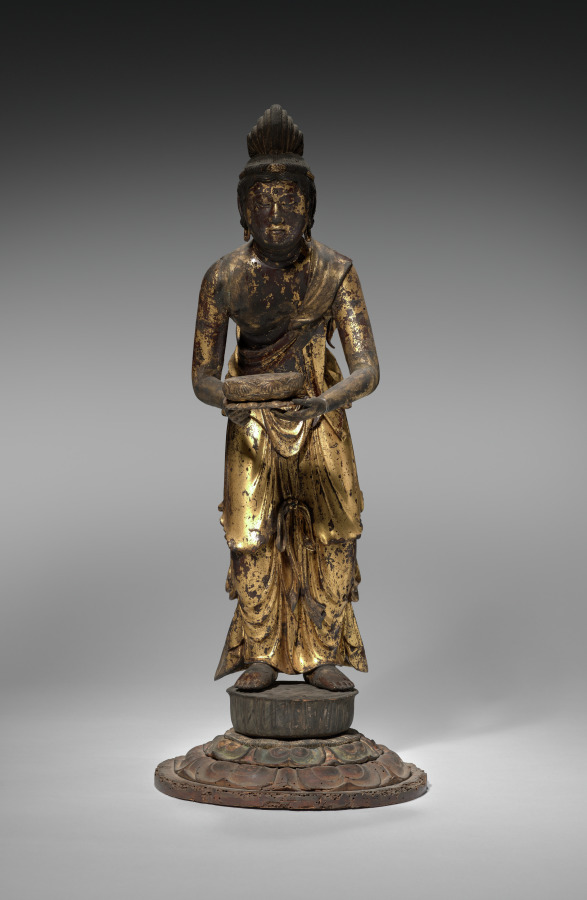
Kannon (early 1200s) is in the Cleveland Museum of Art collection.
The work and its context
The museum's open-access catalogue describes the work:
Kannon, the bodhisattva of compassion, is one of the two bodhisattvas attending Amida, the Buddha of the Western Paradise. The sculpture stands on a lotus pedestal, holding a lotus dais on which the soul of the faithful is received into paradise. The use of gold was prevalent in Buddhist art during this time—it was believed that the yellow light permeated the regions of the Amida—and Amida worship prevailed throughout Japan.
Object facts
- Title: Kannon
- Date: early 1200s
- Culture: Japan, Kamakura period (1185–1333)
- Type: Sculpture
- Technique: wood with lacquer and gold leaf
- Dimensions: with base: 69.2 x 27.7 x 29 cm (27 1/4 x 10 7/8 x 11 7/16 in.); without base: 59.1 x 18.8 x 28 cm (23 1/4 x 7 3/8 x 11 in.)
- Collection: Japanese Art
- Department: Japanese Art
- Accession number: 1919.913
Collection credit
Gift of Ralph King
View the collection record
See the museum's photographs and full catalogue entry. Catalogue text is reproduced from the Cleveland Museum of Art's open-access data, with HTML formatting removed. This object and its supplied image are designated CC0.
Sources
More in Lifestyle
Keep reading