Katar (Stabbing Dagger) (1700s): Art, History and Details
Katar (Stabbing Dagger) at the Cleveland Museum of Art: 1700s, Iron handle with gold inlay; steel blade. Explore the work's context, creator attribution and collection history.
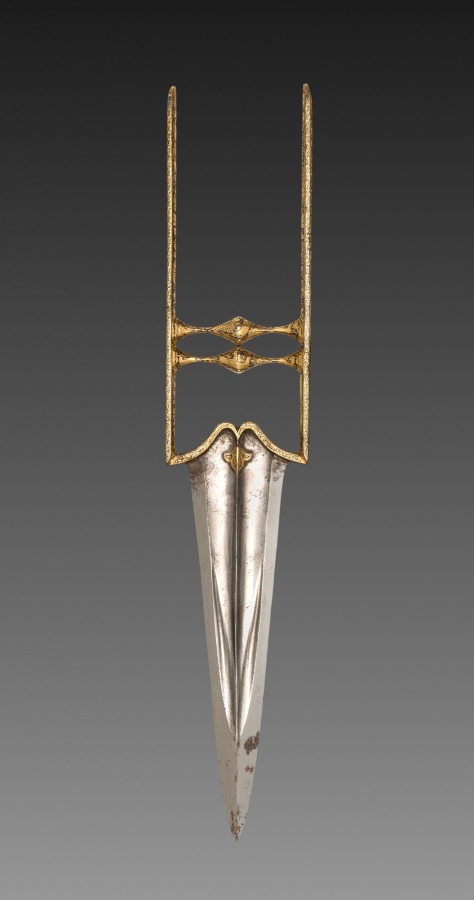
Katar (Stabbing Dagger) (1700s) is in the Cleveland Museum of Art collection.
The work and its context
The museum's open-access catalogue describes the work:
Stabbing daggers called katar were distinctive to India and often worn by soldiers and courtiers, tucked into their belts. Covering the entire handle are tiny scenes of lions and cheetahs hunting deer and buffalo in rocky wooded settings.
Object facts
- Title: Katar (Stabbing Dagger)
- Date: 1700s
- Culture: India, Mughal
- Type: Arms and Armor
- Technique: Iron handle with gold inlay; steel blade
- Dimensions: Overall: 45.6 x 8.2 cm (17 15/16 x 3 1/4 in.)
- Collection: Indian Art
- Department: Indian and Southeast Asian Art
- Accession number: 1985.119.a
A detail from the museum
The ornament on the handle faces up from the perspective of a right-handed user, on all sides.
Collection credit
Gift of Morris and Eleanor Everett
Further reading listed by the museum
- Turner, Evan H. “The Year in Review for 1985.” The Bulletin of the Cleveland Museum of Art 73, no. 2 (February 1986): 26–71.
View the collection record
See the museum's photographs and full catalogue entry. Catalogue text is reproduced from the Cleveland Museum of Art's open-access data, with HTML formatting removed. This object and its supplied image are designated CC0.
Sources
More in Lifestyle
Keep reading