Kero (Waisted Cup) (400–1000): Art, History and Details
Kero (Waisted Cup) at the Cleveland Museum of Art: 400–1000, earthenware with colored slips. Explore the work's context, creator attribution and collection history.
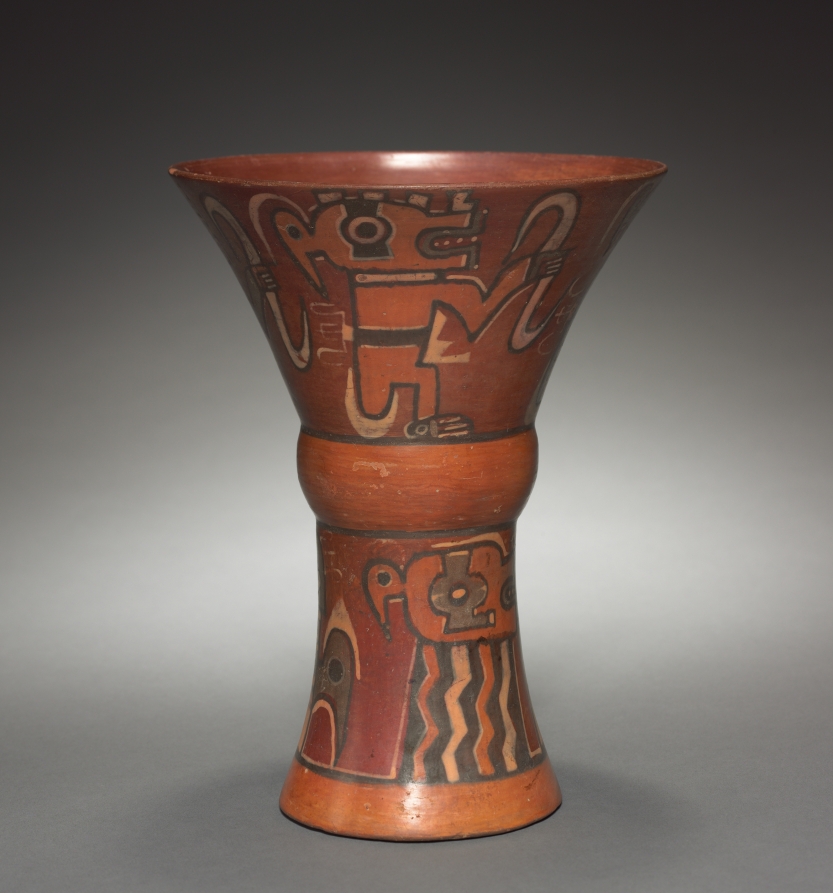
Kero (Waisted Cup) (400–1000) is in the Cleveland Museum of Art collection.
The work and its context
The museum's open-access catalogue describes the work:
The kero is a distinctive Tiwanaku vessel form, imitated by the later Inka, who used the cups in political and religious ceremonies. It is assumed that the same was true at Tiwanaku, where impressive stone figures, perhaps rulers, hold keros as though they are emblems of authority. Perhaps, like the Inka, the Tiwanaku used keros to drink chicha, a corn beer shared to cement bonds of mutual obligation among allies.
Object facts
- Title: Kero (Waisted Cup)
- Date: 400–1000
- Culture: Bolivia, Cochabamba(?), Tiwanaku style, 400-1000
- Type: Ceramic
- Technique: earthenware with colored slips
- Dimensions: Overall: 22.3 x 17 cm (8 3/4 x 6 11/16 in.)
- Collection: AA - Andes
- Department: Art of the Americas
- Accession number: 1963.476
Collection credit
John L. Severance Fund
Further reading listed by the museum
- Ekholm, Gordon F. Pre-Columbian Art, the Native Art of America before the Conquest: Jan. 10-Feb. 1, 1953. Palm Beach, FL: Society of the Four Arts, 1952.
- Purin, Sergio. Inca-Perú: 3000 Ans d’Histoire: Musées Royaux d’Art et d’Histoire, Bruxelles, 21.9-30.12, 1990. Gent: Imschoot, 1990.
- Handbook of the Cleveland Museum of Art. Cleveland, OH: The Museum, 1991.
View the collection record
See the museum's photographs and full catalogue entry. Catalogue text is reproduced from the Cleveland Museum of Art's open-access data, with HTML formatting removed. This object and its supplied image are designated CC0.
Sources
More in Lifestyle
Keep reading