Koto (Zither) (early to mid-1800s): Art, History and Details
Koto (Zither) at the Cleveland Museum of Art: early to mid-1800s, Wood with colored lacquer, sprinkled gold powder (maki-e), textile, and silk strings. Explore the work's context, creator attribution and collection history.
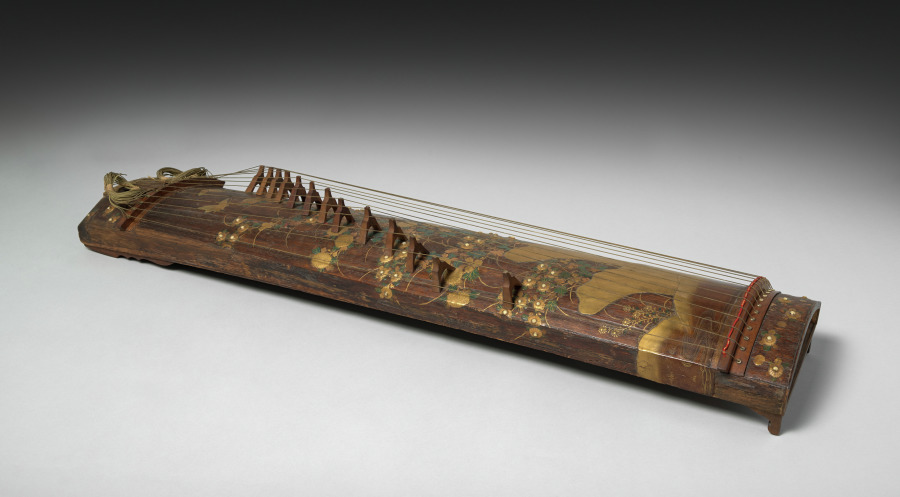
Koto (Zither) (early to mid-1800s) is in the Cleveland Museum of Art collection.
The work and its context
The museum's open-access catalogue describes the work:
This koto has an elaborately decorated surface, suggesting that it was meant to be admired as a decorative object rather than played as a musical instrument. The vertical design shows a profusion of chrysanthemum flowers and miscanthus grass above a brushwood fence as well as a pair of butterflies.
Object facts
- Title: Koto (Zither)
- Date: early to mid-1800s
- Culture: Japan, Edo period (1615–1868)
- Type: Musical Instrument
- Technique: Wood with colored lacquer, sprinkled gold powder (maki-e), textile, and silk strings
- Dimensions: Overall: 117.8 cm (46 3/8 in.); Widest end: 23.8 cm (9 3/8 in.)
- Collection: Japanese Art
- Department: Japanese Art
- Accession number: 1918.359
A detail from the museum
The koto descended from the guzheng, a Chinese zither first imported to Japan in the seventh century.
Collection credit
The Charles G. King Jr. collection; Gift of Ralph King in memory of Charles G. King Jr.
Further reading listed by the museum
- "Accessions." The Bulletin of the Cleveland Museum of Art 5, no. 8/9 (October 1918): 82–85.
- Moore, Douglas S. "Exhibition of Musical Instruments." The Bulletin of the Cleveland Museum of Art 8, no. 9 (November 1921): 134–143.
View the collection record
See the museum's photographs and full catalogue entry. Catalogue text is reproduced from the Cleveland Museum of Art's open-access data, with HTML formatting removed. This object and its supplied image are designated CC0.
Sources
More in Lifestyle
Keep reading