Krishna asks for sweets, from a Sursagar of Surdas (Indian, c. 1480–1580) (1705–10): Art, History and Details
Krishna asks for sweets, from a Sursagar of Surdas (Indian, c. 1480–1580) at the Cleveland Museum of Art: 1705–10, Gum tempera, ink, and gold on paper. Explore the work's context, creator attribution and collection history.
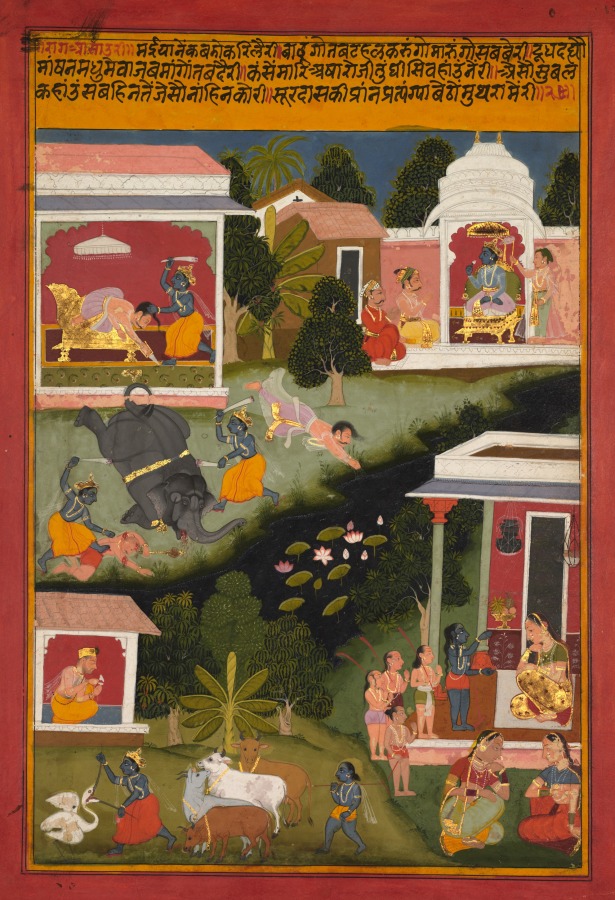
Krishna asks for sweets, from a Sursagar of Surdas (Indian, c. 1480–1580) (1705–10) is in the Cleveland Museum of Art collection.
The work and its context
The museum's open-access catalogue describes the work:
The heart of the scene is at the lower right, where the blue Hindu god Krishna as a boy is trying to persuade his foster mother Yashoda to give him more food. He is in the process of telling her that he needs extra treats so he can grow big to accomplish all the exploits depicted in the remainder of the page: herding cattle, killing demons, defeating wrestlers, and finally winning the throne of Mathura, as seen in the upper right where he sits crowned king in place of his evil uncle Kamsa.
Object facts
- Title: Krishna asks for sweets, from a Sursagar of Surdas (Indian, c. 1480–1580)
- Date: 1705–10
- Culture: Northwestern India, Rajasthan, Rajput Kingdom of Mewar
- Type: Painting
- Technique: Gum tempera, ink, and gold on paper
- Dimensions: Overall: 36.5 x 25.4 cm (14 3/8 x 10 in.)
- Collection: Indian Art
- Department: Indian and Southeast Asian Art
- Accession number: 1984.172
A detail from the museum
In the hut at the lower left sits the blind poet, author of the verse at the top of the page.
Collection credit
Gift of Dr. Norman Zaworski
Further reading listed by the museum
- Turner, Evan H. “The Year in Review for 1984.” The Bulletin of the Cleveland Museum of Art 72, no. 2 (April 1985): 163–207. Published as: Krishna as the Destroyer of Demons
- Diamond, Debra, and Dipti Khera, eds. A Splendid Land: Paintings from Royal Udaipur. Munich, Germany: Hirmer Publishers; Washington, D.C.: National Museum of Asian Art, Smithsonian Institution, 2022.
View the collection record
See the museum's photographs and full catalogue entry. Catalogue text is reproduced from the Cleveland Museum of Art's open-access data, with HTML formatting removed. This object and its supplied image are designated CC0.
Sources
More in Lifestyle
Keep reading