Krishna Stealing Curds (late 1700s): Art, History and Details
Krishna Stealing Curds at the Cleveland Museum of Art: late 1700s, gum tempera and gold on paper. Explore the work's context, creator attribution and collection history.
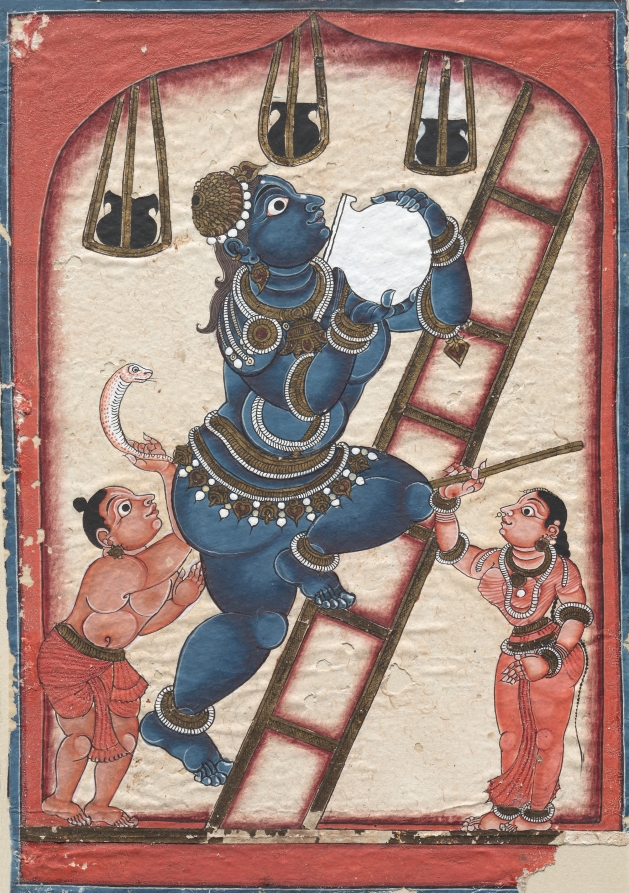
Krishna Stealing Curds (late 1700s) is in the Cleveland Museum of Art collection.
The work and its context
The museum's open-access catalogue describes the work:
As a toddler growing up in a rural cowherding community, Krishna loved to eat the dairy products his parents attempted to keep out of his reach. With bold rounded contours and modeling, the blue-skinned Krishna totters precariously on a ladder, while his irate foster mother brandishes a stick at him.
Object facts
- Title: Krishna Stealing Curds
- Date: late 1700s
- Culture: Southern India, Andhra Pradesh, Tirupati
- Type: Painting
- Technique: gum tempera and gold on paper
- Dimensions: Overall: 27.7 x 19.3 cm (10 7/8 x 7 5/8 in.)
- Collection: Indian Art
- Department: Indian and Southeast Asian Art
- Accession number: 1966.28
A detail from the museum
Krishna’s brother Balarama holds a snake, since he is an incarnation of Vishnu’s cosmic serpent.
Collection credit
John L. Severance Fund
Further reading listed by the museum
- Leach, Linda York. Indian Miniature Paintings and Drawings. Cleveland, OH: Cleveland Museum of Art in cooperation with Indiana University Press, 1986.
View the collection record
See the museum's photographs and full catalogue entry. Catalogue text is reproduced from the Cleveland Museum of Art's open-access data, with HTML formatting removed. This object and its supplied image are designated CC0.
Sources
More in Lifestyle
Keep reading