Laban Searching for His Stolen Household Gods (c. 1665–70): Art, History and Details
Laban Searching for His Stolen Household Gods at the Cleveland Museum of Art: c. 1665–70, oil on canvas. Explore the work's context, creator attribution and collection history.
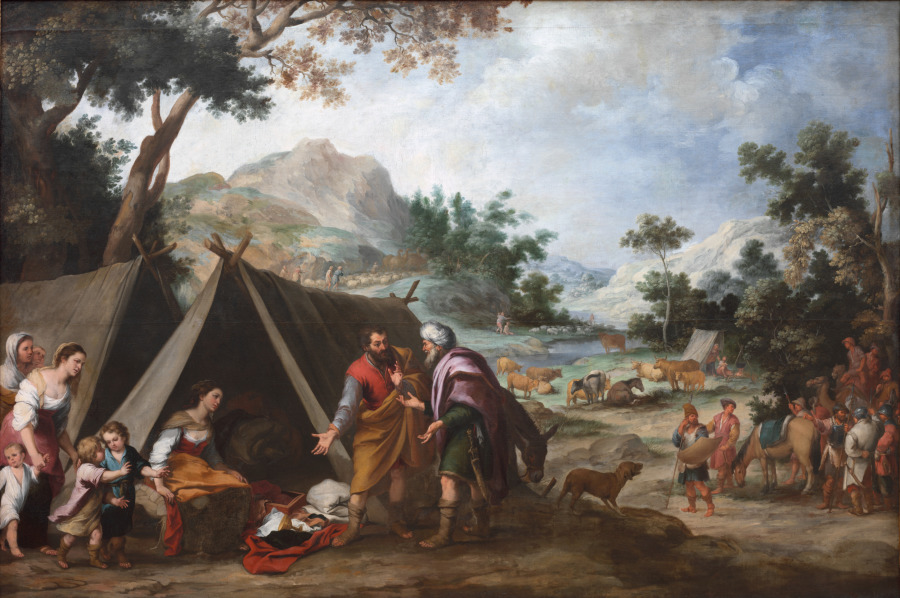
Laban Searching for His Stolen Household Gods (c. 1665–70) is in the Cleveland Museum of Art collection. The museum's creator attribution is Bartolomé Esteban Murillo (Spanish, 1617–1682).
The work and its context
The museum's open-access catalogue describes the work:
This story comes from the Old Testament book of Genesis and stresses the value of reconciliation. Jacob lived with his uncle Laban for years, marrying Laban’s daughters Rachel and Leah. When the relationship between the men soured, Jacob and his family departed, while Rachel secretly stole her father’s household gods. When Laban discovered that the statues were missing, he pursued Jacob, accusing him of theft. Here, Jacob invites Laban to search his tent, while Rachel sits on the saddlebag containing the statues. After coming up empty-handed, Laban proposes a truce, ending the squabble.
Object facts
- Title: Laban Searching for His Stolen Household Gods
- Date: c. 1665–70
- Creator attribution: Bartolomé Esteban Murillo (Spanish, 1617–1682)
- Culture: Spain
- Type: Painting
- Technique: oil on canvas
- Dimensions: Framed: 278 x 398 x 14 cm (109 7/16 x 156 11/16 x 5 1/2 in.); Unframed: 243 x 362 cm (95 11/16 x 142 1/2 in.)
- Collection: P - Spanish before 1800
- Department: European Painting and Sculpture
- Accession number: 1965.469
Collection credit
Gift of the John Huntington Art and Polytechnic Trust
Further reading listed by the museum
- Valdivieso, Enrique. Murillo: catálogo razonado de pinturas. Madrid: Ediciones El Viso, 2010.
- Esteban, Claude, and Juan Antonio Gaya Nuño. Tout l'œuvre peint de Murillo. Paris: Flammarion, 1980.
- Angulo Iñiguez, Diego. Murillo. Madrid: Espasa-Calpe, 1981.
View the collection record
See the museum's photographs and full catalogue entry. Catalogue text is reproduced from the Cleveland Museum of Art's open-access data, with HTML formatting removed. This object and its supplied image are designated CC0.
Sources
More in Lifestyle
Keep reading
Related stories