Lady with a Parasol (early 1800s): Art, History and Details
Lady with a Parasol at the Cleveland Museum of Art: early 1800s, hanging scroll; ink, color, gold, and silver pigments on paper. Explore the work's context, creator attribution and collection history.
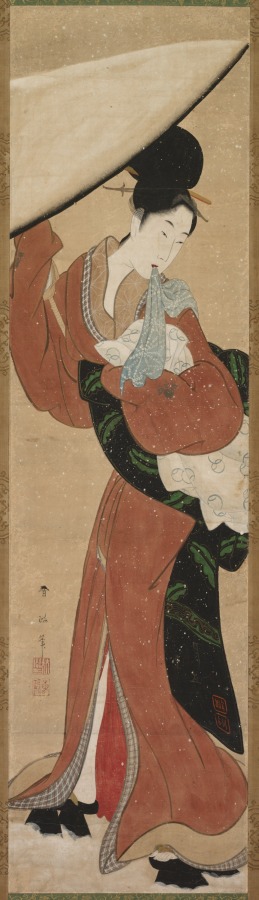
Lady with a Parasol (early 1800s) is in the Cleveland Museum of Art collection. The museum's creator attribution is Koikawa Harumasa (Japanese).
The work and its context
The museum's open-access catalogue describes the work:
This painting depicts a young woman braving the elements as she hurries home from the local bathhouse. The action depicted accentuates her slender neck and bare legs. In later Japanese art, images of beautiful women in bare feet and a towel between their teeth have sensual overtones.
Object facts
- Title: Lady with a Parasol
- Date: early 1800s
- Creator attribution: Koikawa Harumasa (Japanese)
- Culture: Japan, Edo period (1615–1868)
- Type: Painting
- Technique: hanging scroll; ink, color, gold, and silver pigments on paper
- Dimensions: Mounted: 189.4 x 40 cm (74 9/16 x 15 3/4 in.); Painting only: 103 x 27.6 cm (40 9/16 x 10 7/8 in.)
- Collection: ASIAN - Hanging scroll
- Department: Japanese Art
- Accession number: 1985.257
A detail from the museum
Spatters of white paint represent falling snow.
Collection credit
The Kelvin Smith Collection, given by Mrs. Kelvin Smith
Further reading listed by the museum
- Jenkins, Donald. “Paintings of the Floating World.” The Bulletin of the Cleveland Museum of Art 75, no. 7 (September 1988): 244–278.
- Meech, Julia. Rain and Snow: The Umbrella in Japanese Art. New York: Japan Society, 1993.
View the collection record
See the museum's photographs and full catalogue entry. Catalogue text is reproduced from the Cleveland Museum of Art's open-access data, with HTML formatting removed. This object and its supplied image are designated CC0.
Sources
More in Lifestyle
Keep reading