Lampas fragment with blossoms in ogival lattice (1600s): Art, History and Details
Lampas fragment with blossoms in ogival lattice at the Cleveland Museum of Art: 1600s, Silk and silver-metal thread: lampas. Explore the work's context, creator attribution and collection history.
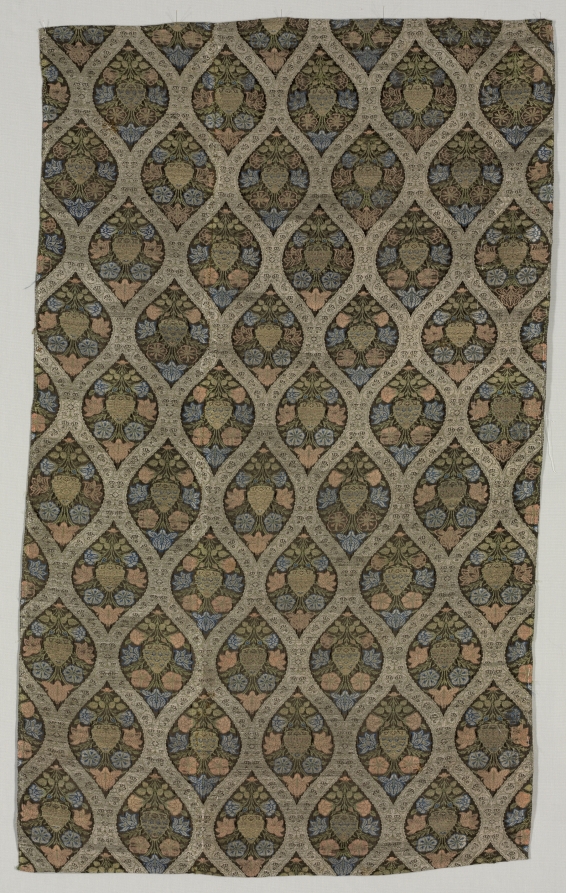
Lampas fragment with blossoms in ogival lattice (1600s) is in the Cleveland Museum of Art collection.
The work and its context
The museum's open-access catalogue describes the work:
The Iranian love of gardens was celebrated in poetry, yet textile patterns composed of blossoming plants only became fashionable in the 1630s, most likely inspired by European botanical engravings, and they dominated for the next 200 years. This design of composite plants within a curving ogival lattice is typically Iranian in the combination of blossoms with a prominent iris, range of colors, and technique with wefts floating, rather than bound in, across the back. However, the lattice layout framing blossoms were, on a larger scale, a hallmark of Ottoman Turkey.
Object facts
- Title: Lampas fragment with blossoms in ogival lattice
- Date: 1600s
- Culture: Iran, Safavid period (1501–1722)
- Type: Textile
- Technique: Silk and silver-metal thread: lampas
- Dimensions: Overall: 114.3 x 68.6 cm (45 x 27 in.); Mounted: 123.8 x 77.5 cm (48 3/4 x 30 1/2 in.)
- Collection: T - Islamic
- Department: Textiles
- Accession number: 1915.666
Collection credit
Gift of the John Huntington Art and Polytechnic Trust
Further reading listed by the museum
- Mackie, Louise W. Symbols of Power: Luxury Textiles from Islamic Lands, 7th-21st Century. Cleveland; New Haven: Cleveland Museum of Art; Yale University Press, 2015.
View the collection record
See the museum's photographs and full catalogue entry. Catalogue text is reproduced from the Cleveland Museum of Art's open-access data, with HTML formatting removed. This object and its supplied image are designated CC0.
Sources
More in Lifestyle
Keep reading