Large Flowering Sensitive Plant, Plate 16 (1799): Art, History and Details
Large Flowering Sensitive Plant, Plate 16 at the Cleveland Museum of Art: 1799, Etching with printed and hand-applied color, aquatint, stipple, and engraving. Explore the work's context, creator attribution and collection history.
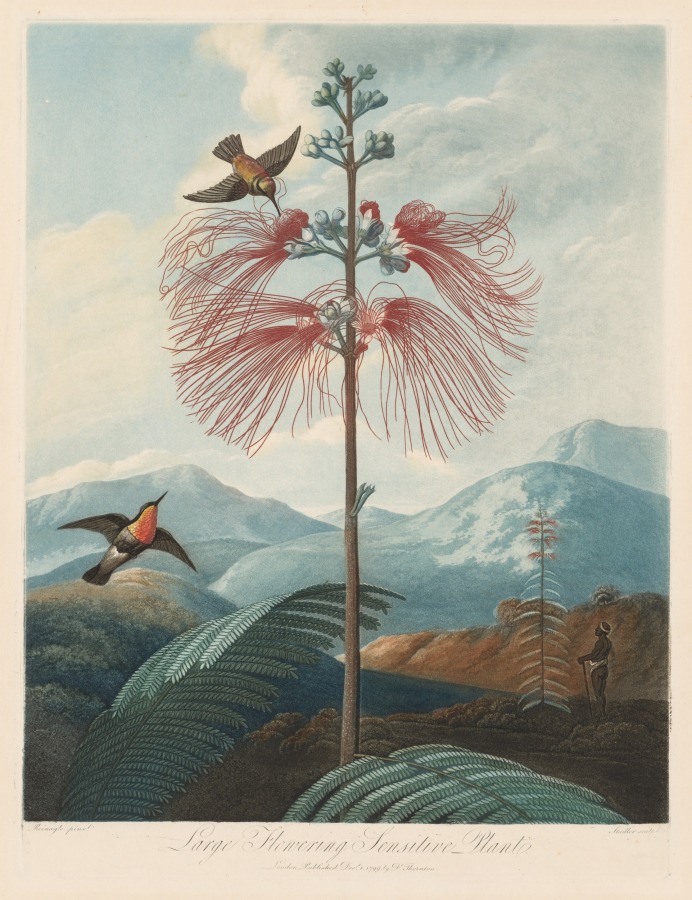
Large Flowering Sensitive Plant, Plate 16 (1799) is in the Cleveland Museum of Art collection. The museum's creator attribution is Joseph Constantine Stadler (German, active 1780–1822); Philip Reinagle (British, 1749–1833); Robert John Thornton (British, 1768–1837).
The work and its context
The museum's open-access catalogue describes the work:
Fueled by scientific and colonial expeditions that brought back plant specimens from across the globe, the science of botany blossomed in Enlightenment Europe. This print is from a sumptuously illustrated treatise known as The Temple of Flora. Commissioned and published by Dr. Robert John Thornton, a British medical botanist, the work illustrates the new plant classification system of Swedish scientist Carl Linnaeus. Yet while these prints realistically depict buds, flowers, and leaves, they show them in environments where they did not actually grow. Instead, Thornton had the artists situate specimens in imagined landscapes, often reminiscent of British colonial holdings, which he felt better suited the plants.
Object facts
- Title: Large Flowering Sensitive Plant, Plate 16
- Date: 1799
- Creator attribution: Joseph Constantine Stadler (German, active 1780–1822); Philip Reinagle (British, 1749–1833); Robert John Thornton (British, 1768–1837)
- Culture: England, late 18th-early 19th Century
- Type: Print
- Technique: Etching with printed and hand-applied color, aquatint, stipple, and engraving
- Dimensions: Image: 44.2 x 35.8 cm (17 3/8 x 14 1/8 in.); Plate: 47.5 x 36 cm (18 11/16 x 14 3/16 in.); Sheet: 53.5 x 43.9 cm (21 1/16 x 17 5/16 in.)
- Collection: PR - Aquatint
- Department: Prints
- Accession number: 1955.479
A detail from the museum
In The Temple of Flora, this print was accompanied by a scientific description and a poem written by Erasmus Darwin (Charles Darwin’s grandfather).
Collection credit
Gift of The Print Club of Cleveland in honor of Mrs. William G. Mather
Further reading listed by the museum
- Glaubinger, Jane. “Flower Power: The history of botanical prints has deep roots.” Cleveland Art: Cleveland Museum of Art Members Magazine 56, no. 3 (May/June 2016): 10-12.
View the collection record
See the museum's photographs and full catalogue entry. Catalogue text is reproduced from the Cleveland Museum of Art's open-access data, with HTML formatting removed. This object and its supplied image are designated CC0.
Sources
More in Lifestyle
Keep reading