Leaf Excised from a Book of Hours: Angel with a Banderole within a Flourished Border (Prayer to the Holy Trinity) (c. 1475): Art, History and Details
Leaf Excised from a Book of Hours: Angel with a Banderole within a Flourished Border (Prayer to the Holy Trinity) at the Cleveland Museum of Art: c. 1475, ink, tempera, and gold on vellum. Explore the work's context, creator attribution and
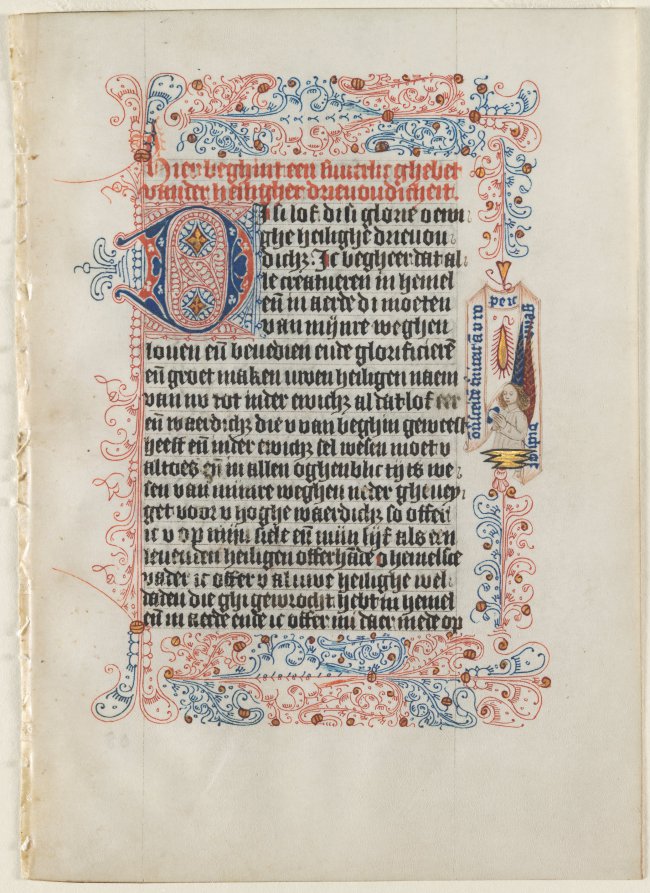
Leaf Excised from a Book of Hours: Angel with a Banderole within a Flourished Border (Prayer to the Holy Trinity) (c. 1475) is in the Cleveland Museum of Art collection. The museum's creator attribution is Workshop of the Convent of St. Agnes (Netherlandish).
The work and its context
The museum's open-access catalogue describes the work:
This leaf provides an excellent example of the high point of the penmanship for which Delft manuscripts were famous. The red and blue penwork flourishes filling the margins of the page belong to what Dutch scholars call the "block group," in which the borders are made up of a number of formal geometric compartments, each tightly filled in with contrasting penwork. This form of decoration appears to be unique to books of hours and breviaries produced in Delft, and therefore points unambiguously to that city as its place of production. An additional feature of this group of manuscripts is the use of emblematic borders in the form of figures with banderoles. These generally relate in some didactic way to the subjects of the texts or main miniatures. Many Delft devotional manuscripts were associated with religious houses that decorated books for the secular market. These included the Augustinian convent of Saint Agnes and the Brothers of the Common Life at Saint Hieronymusdal. Saint Agnes herself was listed in the calendar of the original manuscript for January 21. The text follows Geert Groote’s (died 1384) translation of the book of hours into Dutch. The Netherlands was the only region within Europe in which the vernacular replaced Latin in the book of hours.
Object facts
- Title: Leaf Excised from a Book of Hours: Angel with a Banderole within a Flourished Border (Prayer to the Holy Trinity)
- Date: c. 1475
- Creator attribution: Workshop of the Convent of St. Agnes (Netherlandish)
- Culture: North Netherlands, Delft, 15th century
- Type: Manuscript
- Technique: ink, tempera, and gold on vellum
- Dimensions: Each leaf: 17.7 x 12.5 cm (6 15/16 x 4 15/16 in.)
- Collection: MED - Manuscript Illuminations
- Department: Medieval Art
- Accession number: 1999.133
Collection credit
The Jeanne Miles Blackburn Collection
Further reading listed by the museum
- Fliegel, Stephen N. The Jeanne Miles Blackburn Collection of Manuscript Illuminations. Cleveland, Ohio: Cleveland Museum of Art, 1999.
View the collection record
See the museum's photographs and full catalogue entry. Catalogue text is reproduced from the Cleveland Museum of Art's open-access data, with HTML formatting removed. This object and its supplied image are designated CC0.
Sources
More in Lifestyle
Keep reading