Leaf Excised from Henry of Segusio's "Summa Aurea": Table of Consanguinity (c. 1280): Art, History and Details
Leaf Excised from Henry of Segusio's "Summa Aurea": Table of Consanguinity at the Cleveland Museum of Art: c. 1280, ink, tempera, and gold on parchment. Explore the work's context, creator attribution and collection history.
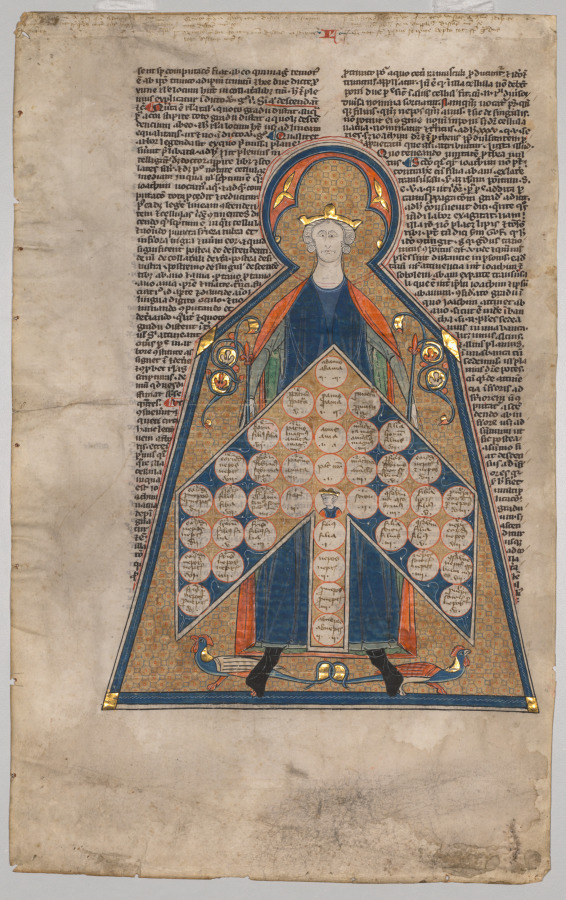
Leaf Excised from Henry of Segusio's "Summa Aurea": Table of Consanguinity (c. 1280) is in the Cleveland Museum of Art collection.
The work and its context
The museum's open-access catalogue describes the work:
Henry of Segusio, a professor of law at the universities of Bologna and Paris, died at Lyon in 1271. His Summa Aurea (Golden Summary) was an early treatise on canon law (church law) that was so important that it was repeatedly copied after his death. This leaf comes from one such early copy.
Object facts
- Title: Leaf Excised from Henry of Segusio's "Summa Aurea": Table of Consanguinity
- Date: c. 1280
- Culture: France, Paris
- Type: Manuscript
- Technique: ink, tempera, and gold on parchment
- Dimensions: Sheet: 44.2 x 27.5 cm (17 3/8 x 10 13/16 in.)
- Collection: MED - Manuscript Illuminations
- Department: Medieval Art
- Accession number: 1954.1
Collection credit
Purchase from the J. H. Wade Fund
Further reading listed by the museum
- Milliken, William. "A Thirteenth-Century Table of Consanguinity." The Bulletin of the Cleveland Museum of Art 41, no. 3 (March 1954): 46-48.
- The Cleveland Museum of Art. The Cleveland Museum of Art Handbook. Cleveland, OH: The Cleveland Museum of Art, 1958.
- Gertsman, Elina and Barbara H. Rosenwein. The Middle Ages in 50 Objects. Cambridge: Cambridge University Press, 2018.
View the collection record
See the museum's photographs and full catalogue entry. Catalogue text is reproduced from the Cleveland Museum of Art's open-access data, with HTML formatting removed. This object and its supplied image are designated CC0.
Sources
More in Lifestyle
Keep reading


