Leaf from a Book of Hours: Ape Hunting Wild Boars (recto) and Ape Fishing (verso) (c. 1500–1510): Art, History and Details
Leaf from a Book of Hours: Ape Hunting Wild Boars (recto) and Ape Fishing (verso) at the Cleveland Museum of Art: c. 1500–1510, ink, tempera and liquid gold on vellum. Explore the work's context, creator attribution and collection history.
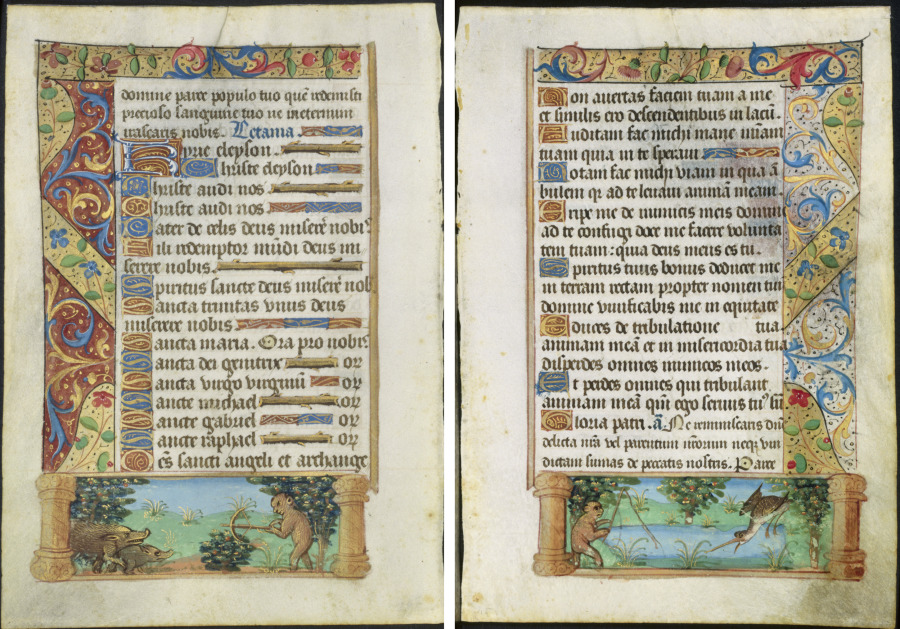
Leaf from a Book of Hours: Ape Hunting Wild Boars (recto) and Ape Fishing (verso) (c. 1500–1510) is in the Cleveland Museum of Art collection.
The work and its context
The museum's open-access catalogue describes the work:
The litany of the saints is among the most ancient and emotional Christian liturgical texts, dating in the West to at least the AD 400s. In a book of hours, the litanies is a list of saints’ names expressed in hierarchical order and individual rank. These names were recited rhythmically as invocations, followed each time by Ora pro nobis (Pray for us). In this way, saints were called upon by sinners seeking forgiveness and salvation. The bas-de-page (lower margin), features an ape hunting wild boars: both animals were symbolic of vice and lust. Perhaps deriving from a fable, the scene could be amusing or diversionary, but it was likely instructive for the medieval owner of the book.
Object facts
- Title: Leaf from a Book of Hours: Ape Hunting Wild Boars (recto) and Ape Fishing (verso)
- Date: c. 1500–1510
- Culture: France, Paris or Rouen, 16th century
- Type: Manuscript
- Technique: ink, tempera and liquid gold on vellum
- Dimensions: Each leaf: 18.1 x 12.9 cm (7 1/8 x 5 1/16 in.)
- Collection: MED - Manuscript Illuminations
- Department: Medieval Art
- Accession number: 2006.13
A detail from the museum
The ape and the wild boar symbolized vice in general and lust in particular during the Middle Ages.
Collection credit
The Jeanne Miles Blackburn Collection
Further reading listed by the museum
- Leroquais, V. Les livres d'heures manuscrits de la Bibliothèque nationale. Paris: [Maçon, Protat frères, impr.], 1927.
- Avril, François, and Nicole Reynaud. Les manuscrits à peintures en France: 1440-1520. Paris: Flammarion, 1993.
- Wieck, Roger S. Painted Prayers: The Book of Hours in Medieval and Renaissance Art. 1997.
View the collection record
See the museum's photographs and full catalogue entry. Catalogue text is reproduced from the Cleveland Museum of Art's open-access data, with HTML formatting removed. This object and its supplied image are designated CC0.
Sources
More in Lifestyle
Keep reading