Leaf from a Kalighat album: Jatayu hinders Ravana’s chariot, trying to prevent the abduction of Sita (recto); Dushyanta watching his son Bharat playing with the tiger at the end of the Abhijnanashakun
Leaf from a Kalighat album: Jatayu hinders Ravana’s chariot, trying to prevent the abduction of Sita (recto); Dushyanta watching his son Bharat playing with the tiger at the end of the Abhijnanashakuntalam (verso) at the Cleveland Museum of
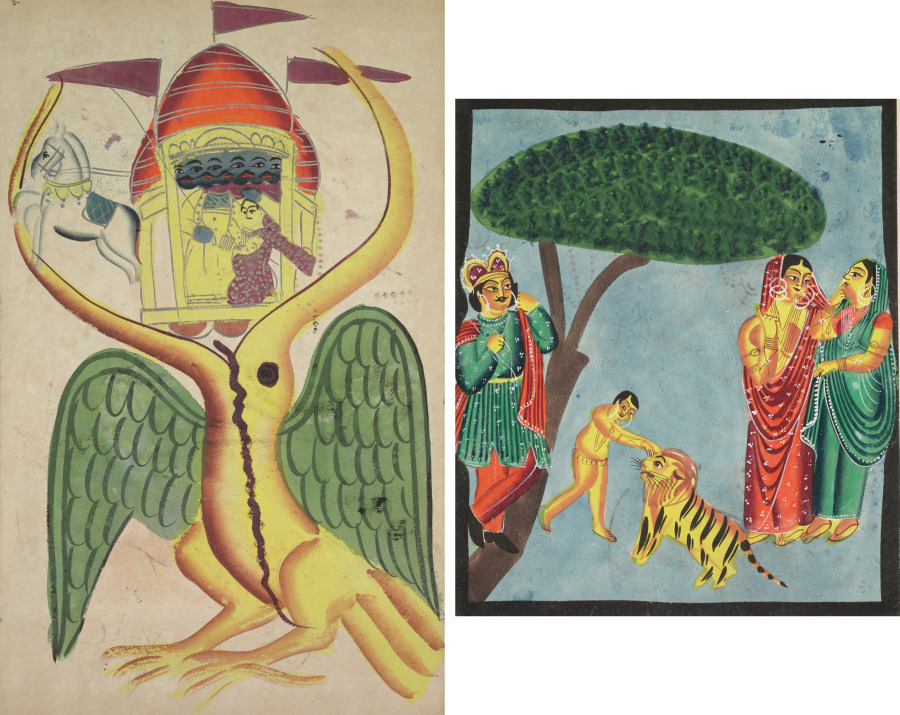
Leaf from a Kalighat album: Jatayu hinders Ravana’s chariot, trying to prevent the abduction of Sita (recto); Dushyanta watching his son Bharat playing with the tiger at the end of the Abhijnanashakuntalam (verso) (c. 1890) is in the Cleveland Museum of Art collection.
The work and its context
The museum's open-access catalogue describes the work:
This is an image of the ten-headed demon Ravana and Sita, wife of Rama, in a chariot held in the beak of the bird Jatayu, king of the vultures. When Ravana abducted Sita and carried her off in the flying chariot, Jatayu, a great devotee of Rama, engaged him in aerial battle to rescue her. Unsuccessful, he fell to earth, mortally wounded. It was from Jatayu that Rama found out about his wife. This story is from the epic Ramayana (The Journey of Rama). Here, in the Bengali version of this episode, Jatayu attempts to swallow the chariot in order to kill Ravana, but is forced to vomit it out once he realizes that Sita is on board. Jatayu is portrayed as a hero rather than as a failure.
Object facts
- Title: Leaf from a Kalighat album: Jatayu hinders Ravana’s chariot, trying to prevent the abduction of Sita (recto); Dushyanta watching his son Bharat playing with the tiger at the end of the Abhijnanashakuntalam (verso)
- Date: c. 1890
- Culture: Eastern India, Bengal, Kolkata, Kalighat
- Type: Painting
- Technique: Gum tempera, graphite, and ink on paper
- Dimensions: Secondary Support: 47.8 x 29.4 cm (18 13/16 x 11 9/16 in.)
- Collection: Indian Art
- Department: Indian and Southeast Asian Art
- Accession number: 2003.109
Collection credit
Gift of William E. Ward in memory of his wife, Evelyn Svec Ward
View the collection record
See the museum's photographs and full catalogue entry. Catalogue text is reproduced from the Cleveland Museum of Art's open-access data, with HTML formatting removed. This object and its supplied image are designated CC0.
Sources
- Leaf from a Kalighat album: Jatayu hinders Ravana’s chariot, trying to prevent the abduction of Sita (recto); Dushyanta watching his son Bharat playing with the tiger at the end of the Abhijnanashakuntalam (verso) (c. 1890; Cleveland 2003.109) — Cleveland Museum of Art
- Cleveland Museum of Art Open Access
More in Lifestyle
Keep reading