Lidded Jar with Horn Handle (400s–500s CE): Art, History and Details
Lidded Jar with Horn Handle at the Cleveland Museum of Art: 400s–500s CE, red earthenware with impressed designs and applied red slip. Explore the work's context, creator attribution and collection history.
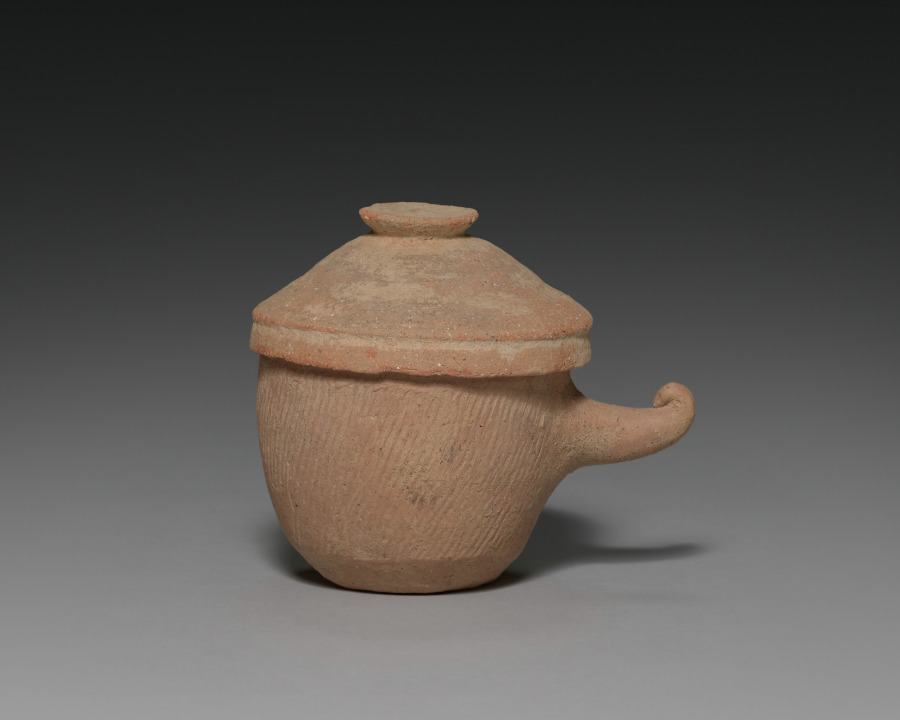
Lidded Jar with Horn Handle (400s–500s CE) is in the Cleveland Museum of Art collection.
The work and its context
The museum's open-access catalogue describes the work:
This type of pottery vessel was a product of closed kilns built on hillsides, which became widely used in Korea during the Three Kingdoms period. Its low-fired red surface indicates the various steps in its fabrication. First, coils of clay were layered on top of one another and pinched together to form the wall of the pot. Then wood mallets with carved surfaces pounded these walls simultaneously, inside and out, merging and thinning the clay bands. Thus the impressed designs visible on both the inner and outer surfaces were functional as well as decorative.
Object facts
- Title: Lidded Jar with Horn Handle
- Date: 400s–500s CE
- Culture: Korea, Silla (57 BCE–935 CE) or Kaya (42–562 CE) period
- Type: Ceramic
- Technique: red earthenware with impressed designs and applied red slip
- Dimensions: Overall: 10.8 cm (4 1/4 in.); 9.1 cm (3 9/16 in.)
- Collection: Korean Art
- Department: Korean Art
- Accession number: 1997.21
A detail from the museum
Closed kilns built on hillsides became widely used for producing this type of pottery vessel in Korea during the Three Kingdoms period.
Collection credit
Gift of the John D. Proctor Foundation
Further reading listed by the museum
- Kim Won-yong. "Problem of Kaya Poettery [伽耶土器의 問題]." Misulsahak yeongu 9 (November 1968): 472–473.
- Kim, Jeong-hak and Kyung Cheol-chin. "Kaya Pottery [加耶土器]." History & the World 3, (February 1979): 153–176.
- Pottery from Ancient Korea: Clay Art for Life and Death [한국고대의토기 : 흙・예술・삶과 죽음]. Seoul: National Museum of Korea, 1997.
View the collection record
See the museum's photographs and full catalogue entry. Catalogue text is reproduced from the Cleveland Museum of Art's open-access data, with HTML formatting removed. This object and its supplied image are designated CC0.
Sources
More in Lifestyle
Keep reading