Lion Aquamanile (1200–1250): Art, History and Details
Lion Aquamanile at the Cleveland Museum of Art: 1200–1250, bronze: cast, chased, and punched. Explore the work's context, creator attribution and collection history.
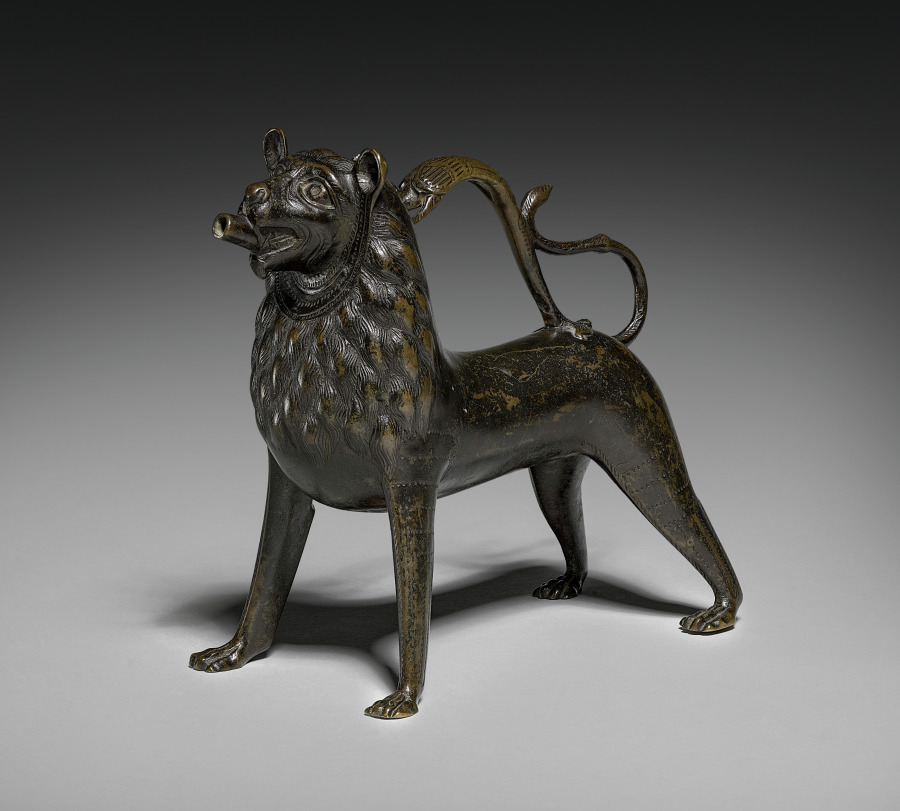
Lion Aquamanile (1200–1250) is in the Cleveland Museum of Art collection.
The work and its context
The museum's open-access catalogue describes the work:
An aquamanile is a water vessel used for washing hands both at church altars and at the dinner tables of upper-class patrons. They often took the form of fantastic beasts such as dragons and unicorns or animals such as horses, birds, dogs, and lions, like this one.
Object facts
- Title: Lion Aquamanile
- Date: 1200–1250
- Culture: Germany, Lower Saxony, Hildesheim, Gothic period, first half 13th century
- Type: Sculpture
- Technique: bronze: cast, chased, and punched
- Dimensions: Overall: 26.4 x 29 x 15 cm (10 3/8 x 11 7/16 x 5 7/8 in.)
- Collection: MED - Gothic
- Department: Medieval Art
- Accession number: 1972.167
A detail from the museum
The handle of this vessel is in the shape of a dragon with a long curving tail.
Collection credit
Gift of Mrs. Chester D. Tripp in honor of Chester D. Tripp
Further reading listed by the museum
- May, Helmut. Weltkunst aus Privatbesitz. Köln: Gesamtherstellung: Druckerei J.P. Bachem, 1968.
- Swarzenski, Hanns, Peter Bloch, Tilmann Buddensieg, Alfred Hentzen, and Theodor Müller. Intuition und Kunstwissenschaft: Festschrift für Hanns Swarzenski zum 70. Geburtstag am 30. August 1973. 1973.
- Wixom, William D., Donald F. Gibbons, and Katherine C. Ruhl. "A Lion Aquamanile." The Bulletin of the Cleveland Museum of Art61, no. 8 (1974)
View the collection record
See the museum's photographs and full catalogue entry. Catalogue text is reproduced from the Cleveland Museum of Art's open-access data, with HTML formatting removed. This object and its supplied image are designated CC0.
Sources
More in Lifestyle
Keep reading