Lion's Head (500–400 BCE): Art, History and Details
Lion's Head at the Cleveland Museum of Art: 500–400 BCE, terracotta. Explore the work's context, creator attribution and collection history.
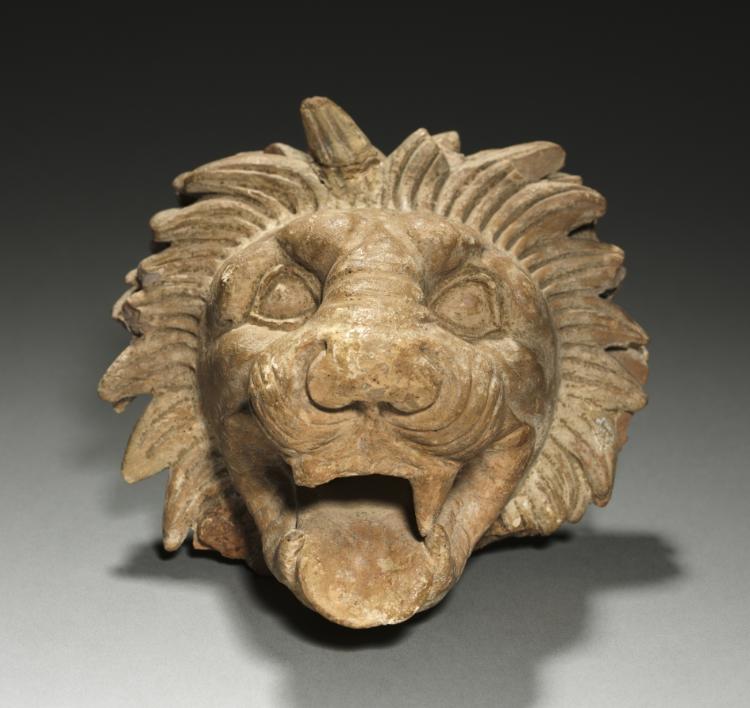
Lion's Head (500–400 BCE) is in the Cleveland Museum of Art collection.
The work and its context
The museum's open-access catalogue describes the work:
This terracotta sculpture is molded in the shape of a lion’s head. The lion opens its mouth and lolls out its tongue, showing off large upper and lower incisors (broken on one side). A mane spreads out around the lion’s head, framing the face. Lion heads like this one often served as architectural decoration.
Object facts
- Title: Lion's Head
- Date: 500–400 BCE
- Culture: Greece
- Type: Sculpture
- Technique: terracotta
- Dimensions: Overall: 24.3 cm (9 9/16 in.)
- Collection: GR - Greek
- Department: Greek and Roman Art
- Accession number: 1927.27
A detail from the museum
Lions once roamed the lands around ancient Greece but were probably extinct in the region by the 2nd century BCE.
Collection credit
The A. W. Ellenberger, Sr., Endowment Fund
Further reading listed by the museum
- The Cleveland Museum of Art. Handbook of the Cleveland Museum of Art/1966. Cleveland, OH: The Cleveland Museum of Art, 1966.
- The Cleveland Museum of Art. Handbook of the Cleveland Museum of Art/1969. Cleveland, OH: The Cleveland Museum of Art, 1969.
- The Cleveland Museum of Art. Handbook of the Cleveland Museum of Art/1978. Cleveland, OH: The Cleveland Museum of Art, 1978.
View the collection record
See the museum's photographs and full catalogue entry. Catalogue text is reproduced from the Cleveland Museum of Art's open-access data, with HTML formatting removed. This object and its supplied image are designated CC0.
Sources
More in Lifestyle
Keep reading