Locket (1700s): Art, History and Details
Locket at the Cleveland Museum of Art: 1700s, gold and enamel. Explore the work's context, creator attribution and collection history.
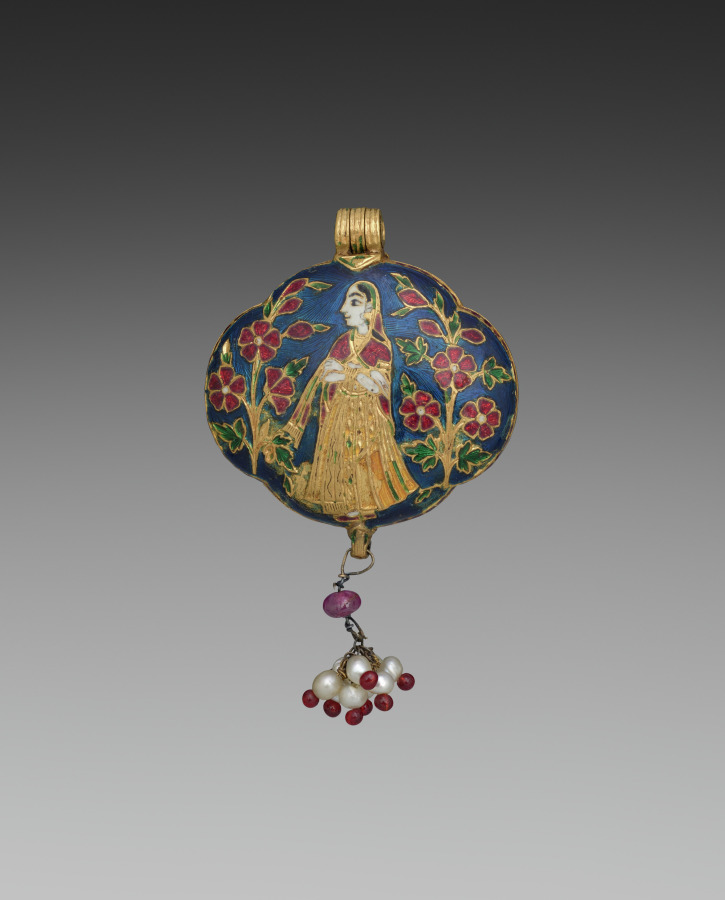
Locket (1700s) is in the Cleveland Museum of Art collection.
The work and its context
The museum's open-access catalogue describes the work:
This locket may have once been an amulet containing prayers and talismans or a container for perfume or other cosmetic items. At the center, a young woman stands between two groupings of large red flowers. The connections between women and nature have ancient precedents in India, often communicating auspicious fertility. Luxury enamels like this were the hallmark of 18th-century Jaipur goldsmiths and jewelry makers. This locket was given to the museum by the Twentieth Century Club, a women’s community group founded in the early 1900s with satellites across the United States.
Object facts
- Title: Locket
- Date: 1700s
- Culture: Northwestern India, Rajasthan, Rajput Kingdom of Jaipur
- Type: Jewelry
- Technique: gold and enamel
- Dimensions: Case: 3.1 x 3.5 cm (1 1/4 x 1 3/8 in.)
- Collection: Indian Art
- Department: Indian and Southeast Asian Art
- Accession number: 1960.198
A detail from the museum
Green glass, now mostly lost, once filled the lozenge shapes in the woman’s gown.
Collection credit
Gift of the Twentieth Century Club
Further reading listed by the museum
- Lee, Sherman E. “Year in Review | 1960.” The Bulletin of the Cleveland Museum of Art 47, no. 10 (1960): 223–254.
- Fyson, Nance Lui. Great Treasures of the World. Basingstoke: The Automobile Association, 1997.
View the collection record
See the museum's photographs and full catalogue entry. Catalogue text is reproduced from the Cleveland Museum of Art's open-access data, with HTML formatting removed. This object and its supplied image are designated CC0.
Sources
More in Lifestyle
Keep reading