Lotus-blossom petal canopy (c. 1600): Art, History and Details
Lotus-blossom petal canopy at the Cleveland Museum of Art: c. 1600, silk: lampas. Explore the work's context, creator attribution and collection history.
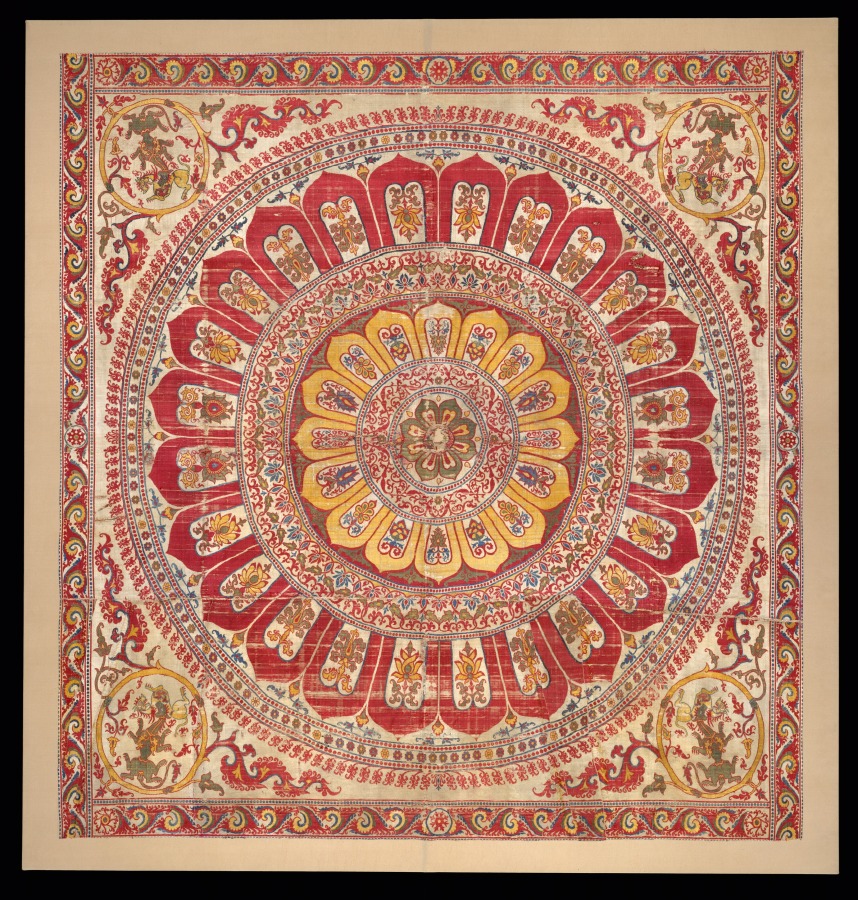
Lotus-blossom petal canopy (c. 1600) is in the Cleveland Museum of Art collection.
The work and its context
The museum's open-access catalogue describes the work:
The ceilings of sacred spaces throughout India were carved or painted with concentric circular lotus patterns; many also included textile canopies with the same designs. This exceptionally large example was woven in one complete section on a single loom. In India, the full-blown lotus flower bears solar connotations. It projects the radiance of a sacred or royal presence below. The motif of a dragon bearing down on a winged lion in each of the four corners indicates the designer’s recognition of a motif popular across Islamic Asia, from Turkey to Iran and Mughal India.
Object facts
- Title: Lotus-blossom petal canopy
- Date: c. 1600
- Culture: Northern India
- Type: Textile
- Technique: silk: lampas
- Dimensions: Overall: 186.7 x 175.7 cm (73 1/2 x 69 3/16 in.); Mounted: 191.8 x 203.2 cm (75 1/2 x 80 in.)
- Collection: T - Islamic
- Department: Textiles
- Accession number: 2006.136
Collection credit
Purchase from the J. H. Wade Fund
Further reading listed by the museum
- Mackie, Louise W. Symbols of Power: Luxury Textiles from Islamic Lands, 7th-21st Century. Cleveland; New Haven: Cleveland Museum of Art; Yale University Press, 2015.
View the collection record
See the museum's photographs and full catalogue entry. Catalogue text is reproduced from the Cleveland Museum of Art's open-access data, with HTML formatting removed. This object and its supplied image are designated CC0.
Sources
More in Lifestyle
Keep reading