Love at the Brothel Gate (late 1760s): Art, History and Details
Love at the Brothel Gate at the Cleveland Museum of Art: late 1760s, color woodblock print. Explore the work's context, creator attribution and collection history.
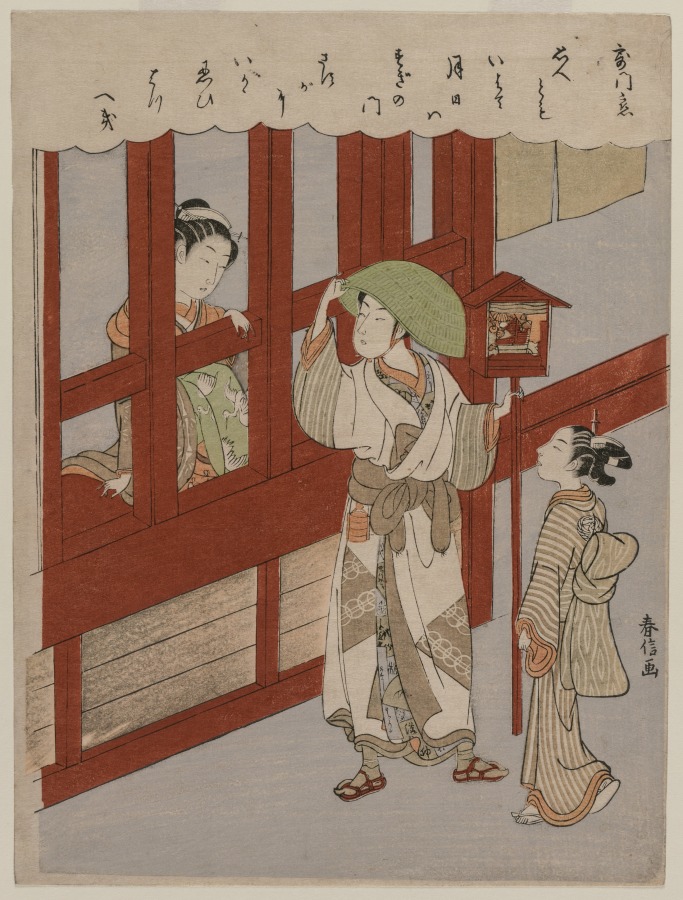
Love at the Brothel Gate (late 1760s) is in the Cleveland Museum of Art collection. The museum's creator attribution is Suzuki Harunobu (Japanese, 1724–1770).
The work and its context
The museum's open-access catalogue describes the work:
Courtesans were on display to potential clients through bars, an aspect of their jobs that also afforded an opportunity to have socially distanced interactions with fellow entertainment district denizens. Here, a courtesan with a crane motif on her obi sash converses with her lover, a young man carrying a miniature theater. The poem in the cloud above them comes from New Collection of Poems Ancient and Modern (新古今和歌集) and reads, Although I yearn, I do not speak as days and months, pass by behind my cedar gate. How can I endure keeping this secret within?
Object facts
- Title: Love at the Brothel Gate
- Date: late 1760s
- Creator attribution: Suzuki Harunobu (Japanese, 1724–1770)
- Culture: Japan, Edo period (1615–1868)
- Type: Print
- Technique: color woodblock print
- Dimensions: Sheet: 29 x 21.7 cm (11 7/16 x 8 9/16 in.)
- Collection: Japanese Art
- Department: Japanese Art
- Accession number: 1921.349
Collection credit
Gift of J. H. Wade
View the collection record
See the museum's photographs and full catalogue entry. Catalogue text is reproduced from the Cleveland Museum of Art's open-access data, with HTML formatting removed. This object and its supplied image are designated CC0.
Sources
More in Lifestyle
Keep reading