Luster Dish with Seated Prince (1170–1220): Art, History and Details
Luster Dish with Seated Prince at the Cleveland Museum of Art: 1170–1220, fritware with luster-painted design. Explore the work's context, creator attribution and collection history.
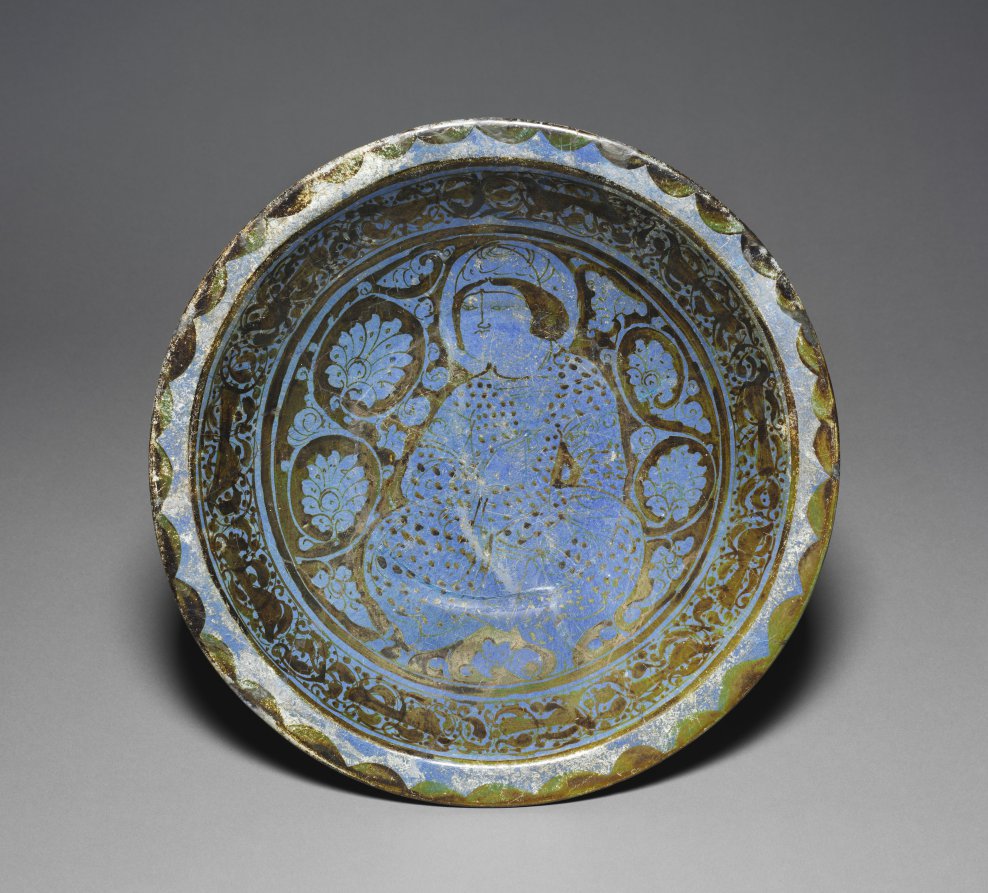
Luster Dish with Seated Prince (1170–1220) is in the Cleveland Museum of Art collection.
The work and its context
The museum's open-access catalogue describes the work:
Along with Basra in Iraq and Fustat (Old Cairo) in Egypt, Kashan served as a hub of Islamic ceramic production in northern Iran. This dish was likely produced in one of its workshops and is admired for its rare blue glaze design on a luster ground. Rulers and other court officials are commonly depicted on lusterware of this period.
Object facts
- Title: Luster Dish with Seated Prince
- Date: 1170–1220
- Culture: Iran, Kashan, Seljuq period of Iran (1037–1194)
- Type: Ceramic
- Technique: fritware with luster-painted design
- Dimensions: Overall: 7.5 x 39 cm (2 15/16 x 15 3/8 in.)
- Collection: Islamic Art
- Department: Islamic Art
- Accession number: 1951.289
A detail from the museum
Around the dish's edge is a frieze of birds against an arabesque field.
Collection credit
John L. Severance Fund
Further reading listed by the museum
- Shepherd, Dorothy. "A Luster Bowl from Gurgan." The Bulletin of the Cleveland Museum of Art 44, no. 9 (November 1957): 196–197.
- The Cleveland Museum of Art. The Cleveland Museum of Art Handbook. Cleveland, OH: The Cleveland Museum of Art, 1958.
- The Cleveland Museum of Art. Handbook of the Cleveland Museum of Art/1966. Cleveland, OH: The Cleveland Museum of Art, 1966.
View the collection record
See the museum's photographs and full catalogue entry. Catalogue text is reproduced from the Cleveland Museum of Art's open-access data, with HTML formatting removed. This object and its supplied image are designated CC0.
Sources
More in Lifestyle
Keep reading