Luxury Ewer Extending Good Fortune to the Owner (1223): Art, History and Details
Luxury Ewer Extending Good Fortune to the Owner at the Cleveland Museum of Art: 1223, brass inlaid with silver; lid and base added later. Explore the work's context, creator attribution and collection history.
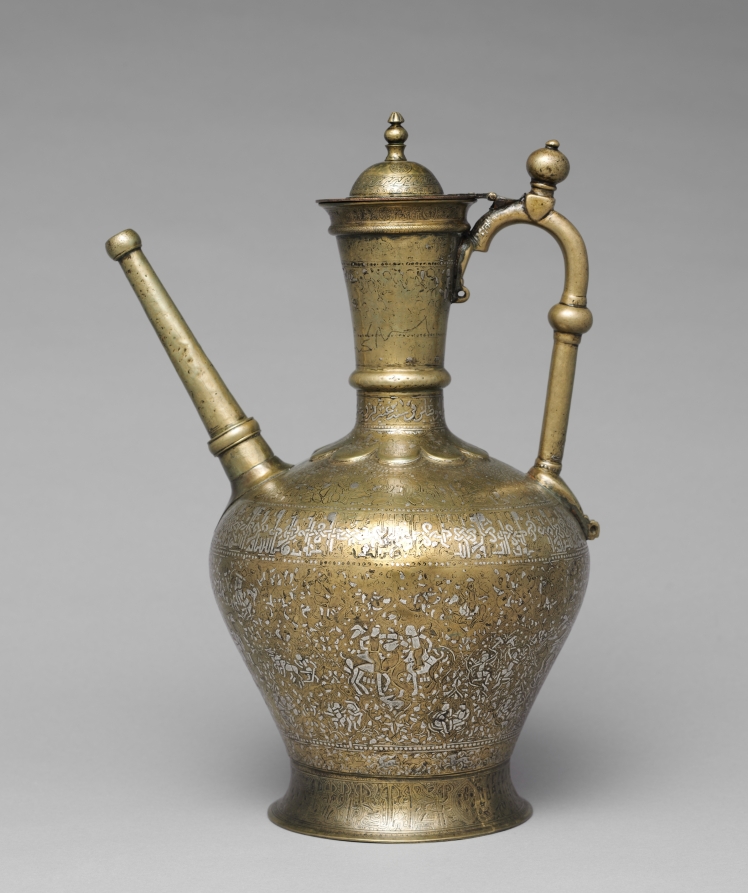
Luxury Ewer Extending Good Fortune to the Owner (1223) is in the Cleveland Museum of Art collection. The museum's creator attribution is Ahmad al-Dhaki al-Mawsili (Iraqi, Mosul, active early 1200s?).
The work and its context
The museum's open-access catalogue describes the work:
This silver inlaid ewer was produced for luxury clientele. The wide band around the body of the vessel displays vignettes of daily and courtly life contained within multilobed medallions. Some of the scenes feature falconry, hunting, dancing, and several groups of musicians. All these scenes are set off against a skillfully executed arabesque background—a pervasive motif in Islamic art characterized by interwoven vegetal and curvilinear elements. An inscription around the ewer’s shoulder extends good fortune, prosperity, and peace to the owner. The ewer is dated 1223 and signed by the master craftsman Ahmad al-Dhaki of Mosul.
Object facts
- Title: Luxury Ewer Extending Good Fortune to the Owner
- Date: 1223
- Creator attribution: Ahmad al-Dhaki al-Mawsili (Iraqi, Mosul, active early 1200s?)
- Culture: Iraq, possibly Mosul, Zangid or Artugid Period, 13th Century
- Type: Metalwork
- Technique: brass inlaid with silver; lid and base added later
- Dimensions: Diameter: 26.6 cm (10 1/2 in.); Overall: 37.9 cm (14 15/16 in.); Diameter of base: 14.5 cm (5 11/16 in.)
- Collection: Islamic Art
- Department: Islamic Art
- Accession number: 1956.11
A detail from the museum
Later owners roughly scratched their names into the neck of the ewer.
Collection credit
John L. Severance Fund
Further reading listed by the museum
- Rice, D. S. “Inlaid Brasses from the Workshop of Aḥmad Al-Dhakī Al-Mawṣilī.” Ars Orientalis, vol. 2, 1957, pp. 283–326.
- The Cleveland Museum of Art. The Cleveland Museum of Art Handbook. Cleveland, OH: The Cleveland Museum of Art, 1958.
- Milliken, William M. “Early Byzantine Silver.” The Bulletin of the Cleveland Museum of Art, vol. 45, no. 3, 1958, pp. 35–94.
View the collection record
See the museum's photographs and full catalogue entry. Catalogue text is reproduced from the Cleveland Museum of Art's open-access data, with HTML formatting removed. This object and its supplied image are designated CC0.
Sources
More in Lifestyle
Keep reading