Man Dhata in Yogi Position (c. 1690–1700): Art, History and Details
Man Dhata in Yogi Position at the Cleveland Museum of Art: c. 1690–1700, Gum tempera and ink on paper. Explore the work's context, creator attribution and collection history.
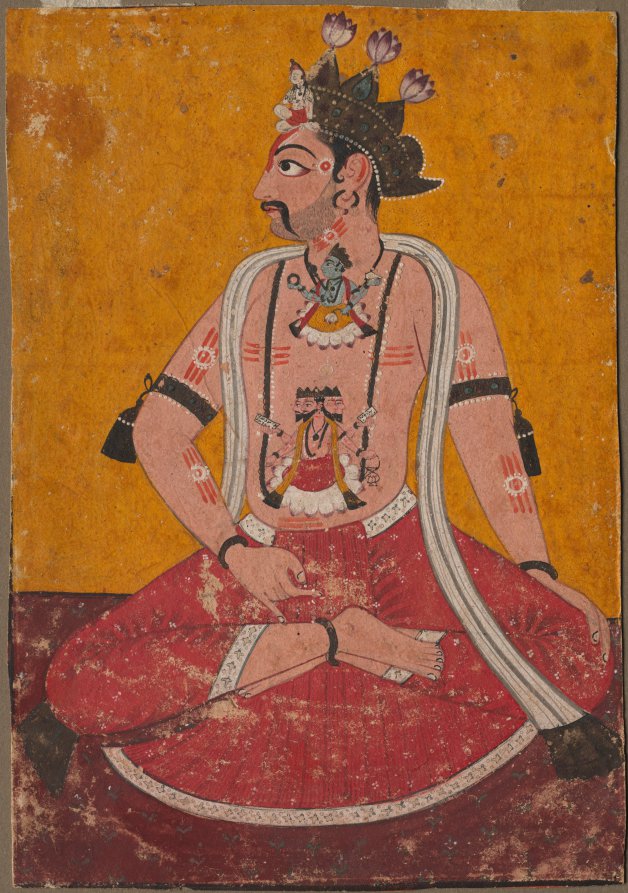
Man Dhata in Yogi Position (c. 1690–1700) is in the Cleveland Museum of Art collection.
The work and its context
The museum's open-access catalogue describes the work:
An unconventional ruler portrait depicts Raja Mandhata of Nurpur (reigned 1661/1667–1700) engaged in yogic practice, raising his breath to pierce the three knots (ghranti) of the subtle body. The knots, which are located at the base of the spine, the heart, and between the eyebrows, are identified, respectively, with the deities Brahma, Vishnu, and Rudra (Shiva). This rare image of the ghranti points to the key role that kings played in creating yoga’s visual culture.
Object facts
- Title: Man Dhata in Yogi Position
- Date: c. 1690–1700
- Culture: India, Pahari, Nurpur, late 17th Century
- Type: Painting
- Technique: Gum tempera and ink on paper
- Dimensions: Overall: 20 x 14 cm (7 7/8 x 5 1/2 in.)
- Collection: Indian Art
- Department: Indian and Southeast Asian Art
- Accession number: 1966.27
Collection credit
Edward L. Whittemore Fund
Further reading listed by the museum
- Dwivedi, Vinod P. “A Rasamanjari Painting from Basohli.” The Bulletin of the Cleveland Museum of Art 56, no. 7 (September 1969): 262–268.
- The Cleveland Museum of Art. Handbook of the Cleveland Museum of Art/1978. Cleveland, OH: The Cleveland Museum of Art, 1978.
- Kramrisch, Stella. Manifestations of Shiva. Philadelphia: Philadelphia Museum of Art, 1981.
View the collection record
See the museum's photographs and full catalogue entry. Catalogue text is reproduced from the Cleveland Museum of Art's open-access data, with HTML formatting removed. This object and its supplied image are designated CC0.
Sources
More in Lifestyle
Keep reading