Mandala Base (early 1400s): Art, History and Details
Mandala Base at the Cleveland Museum of Art: early 1400s, cloisonné enamel. Explore the work's context, creator attribution and collection history.
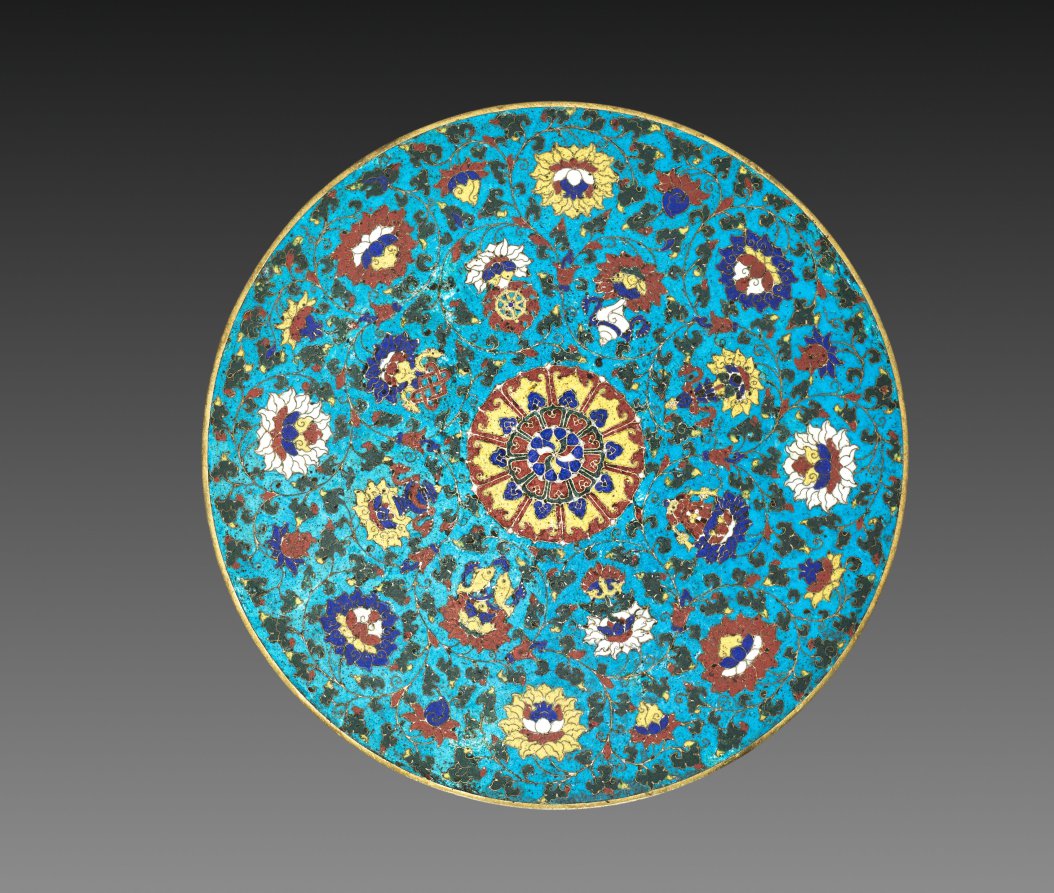
Mandala Base (early 1400s) is in the Cleveland Museum of Art collection.
The work and its context
The museum's open-access catalogue describes the work:
A ritual object of Tibetan Buddhism, this cloisonné disc is used as the base for a three-dimensional mandala composed of miniature buildings. The decoration includes the lotus flowers and the Eight Buddhist Treasures: the wheel, the conch, the umbrella, the canopy, the lotus, the paired fish, the vase, and the endless knot.
Object facts
- Title: Mandala Base
- Date: early 1400s
- Culture: China, Ming dynasty (1368–1644)
- Type: Enamel
- Technique: cloisonné enamel
- Dimensions: Diameter: 30.8 cm (12 1/8 in.)
- Collection: China - Ming Dynasty
- Department: Chinese Art
- Accession number: 1987.58
A detail from the museum
In a meditation ritual known as Offering the Universe, the disc functioned as a mandala or cosmic diagram.
Collection credit
Purchase from the J. H. Wade Fund
Further reading listed by the museum
- Turner, Evan H. "The Year in Review for 1987." The Bulletin of the Cleveland Museum of Art 75, no. 2 (1988): 30-71.
- Cunningham, Michael R., Stanislaw J. Czuma, Anne E. Wardwell, and J. Keith Wilson. Masterworks of Asian Art. Cleveland, OH: The Cleveland Museum of Art, 1998.
- Huntington, John C., Dina Bangdel, and Robert A. F. Thurman. The Circle of Bliss: Buddhist Meditational Art. Chicago: Serindia Publications, 2003.
View the collection record
See the museum's photographs and full catalogue entry. Catalogue text is reproduced from the Cleveland Museum of Art's open-access data, with HTML formatting removed. This object and its supplied image are designated CC0.
Sources
More in Lifestyle
Keep reading

![Sketch of a Sphinx [?] (verso) (c. 1879–80; Cleveland 1997.178.b)](https://openaccess-cdn.clevelandart.org/1997.178.b/1997.178.b_web.jpg)