Mandaya textile (composite dagmay) (c. early 1900s): Art, History and Details
Mandaya textile (composite dagmay) at the Cleveland Museum of Art: c. early 1900s, plain weave hemp, dyed. Explore the work's context, creator attribution and collection history.
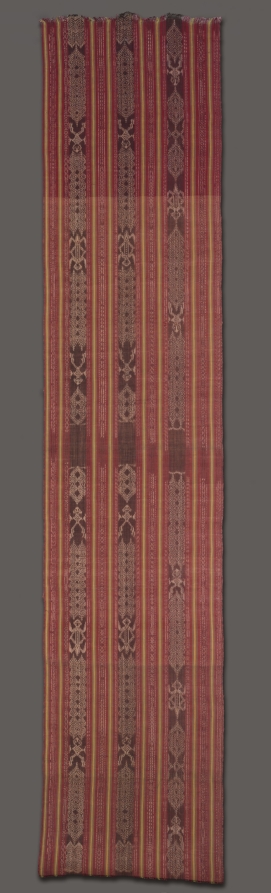
Mandaya textile (composite dagmay) (c. early 1900s) is in the Cleveland Museum of Art collection.
The work and its context
The museum's open-access catalogue describes the work:
This textile strikingly fuses two different weaving traditions and materials: abacá ikat (dagmay) for the patterned sections, and commercially or locally dyed cotton for the plain-weave intervals. This combination is an inventive Mandaya solution for creating a cloth that retains ritual meaning through its abacá ikat components, while achieving comfort, flexibility, and drape through the inclusion of cotton.
Object facts
- Title: Mandaya textile (composite dagmay)
- Date: c. early 1900s
- Culture: Philippines, Mindanao
- Type: Textile
- Technique: plain weave hemp, dyed
- Dimensions: Overall: 320 x 67.3 cm (126 x 26 1/2 in.)
- Collection: Textiles
- Department: Textiles
- Accession number: 1917.747
A detail from the museum
Abacá, a banana fiber, is associated with protection, balance, and the presence of umagad (ancestral spirits).
Collection credit
Gift of Mrs. G. Field Adams
View the collection record
See the museum's photographs and full catalogue entry. Catalogue text is reproduced from the Cleveland Museum of Art's open-access data, with HTML formatting removed. This object and its supplied image are designated CC0.
Sources
More in Lifestyle
Keep reading