Mantle Border Fragment with Oculate Being (200 BCE–200 CE): Art, History and Details
Mantle Border Fragment with Oculate Being at the Cleveland Museum of Art: 200 BCE–200 CE, camelid fiber, embroidery over foundation cloth. Explore the work's context, creator attribution and collection history.
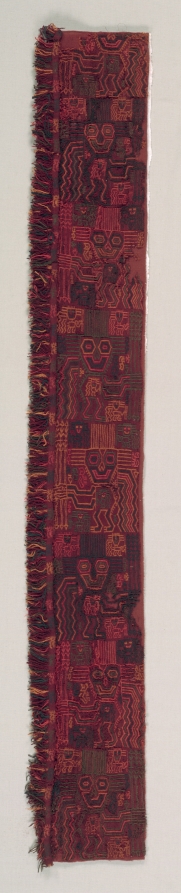
Mantle Border Fragment with Oculate Being (200 BCE–200 CE) is in the Cleveland Museum of Art collection.
The work and its context
The museum's open-access catalogue describes the work:
This border fragment features a supernatural being apparently at the center of a religion that swept the south coast during the final stages of the Paracas culture. Known as the Oculate Being after its huge eyes, it is affiliated with fertility and violence—note the darts it holds in one hand. Both large and small versions of the being are embroidered on the fragment, which likely comes from the border of a large, rectangular, shawl-like garment known as a mantle.
Object facts
- Title: Mantle Border Fragment with Oculate Being
- Date: 200 BCE–200 CE
- Culture: Peru, South Coast, Paracas (Cavernas) style (700 BCE–1 CE)
- Type: Embroidery
- Technique: camelid fiber, embroidery over foundation cloth
- Dimensions: Overall: 116.2 x 16.5 cm (45 3/4 x 6 1/2 in.); Mounted: 127 x 25.4 cm (50 x 10 in.)
- Collection: T - Pre-Columbian
- Department: Textiles
- Accession number: 1985.193
Collection credit
Gift of The Textile Art Alliance
View the collection record
See the museum's photographs and full catalogue entry. Catalogue text is reproduced from the Cleveland Museum of Art's open-access data, with HTML formatting removed. This object and its supplied image are designated CC0.
Sources
More in Lifestyle
Keep reading