Mary Cassatt at the Louvre: The Etruscan Gallery (1879–80): Art, History and Details
Mary Cassatt at the Louvre: The Etruscan Gallery at the Cleveland Museum of Art: 1879–80, softground etching, drypoint, aquatint, and etching. Explore the work's context, creator attribution and collection history.
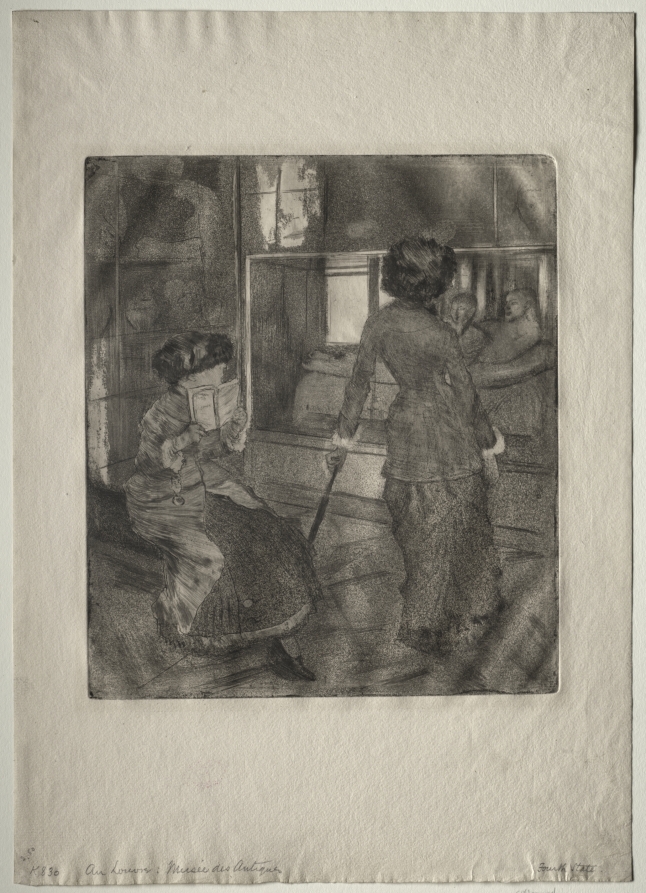
Mary Cassatt at the Louvre: The Etruscan Gallery (1879–80) is in the Cleveland Museum of Art collection. The museum's creator attribution is Edgar Degas (French, 1834–1917).
The work and its context
The museum's open-access catalogue describes the work:
This print is one of two in which Edgar Degas depicted Mary Cassatt and her sister Lydia at the Musée du Louvre. In this iteration of the subject, Casatt gazes intently at an Etruscan tomb, about 500 BC, excavated at Cerveteri, the largest ancient necropolis in the Mediterranean. Cassatt is viewed from behind while the enigmatically smiling couple, lying on top of a sarcophagus and enclosed in a glass case, face the viewer. Cassatt confronts the sculpture directly while Lydia reads about it in a guidebook.
Object facts
- Title: Mary Cassatt at the Louvre: The Etruscan Gallery
- Date: 1879–80
- Creator attribution: Edgar Degas (French, 1834–1917)
- Culture: France, 19th century
- Type: Print
- Technique: softground etching, drypoint, aquatint, and etching
- Dimensions: Platemark: 26.7 x 23.2 cm (10 1/2 x 9 1/8 in.)
- Collection: PR - Etching
- Department: Prints
- Accession number: 1929.877
Collection credit
The Charles W. Harkness Endowment Fund
Further reading listed by the museum
- Richards, Louise S. “Mary Cassatt’s Drawing of the Visitor.” The Bulletin of the Cleveland Museum of Art 65, no. 8 (October 1978): 268–276.
View the collection record
See the museum's photographs and full catalogue entry. Catalogue text is reproduced from the Cleveland Museum of Art's open-access data, with HTML formatting removed. This object and its supplied image are designated CC0.
Sources
More in Lifestyle
Keep reading