Mask (late 1800s–early 1900s): Art, History and Details
Mask at the Cleveland Museum of Art: late 1800s–early 1900s, wood (alder), pigment. Explore the work's context, creator attribution and collection history.
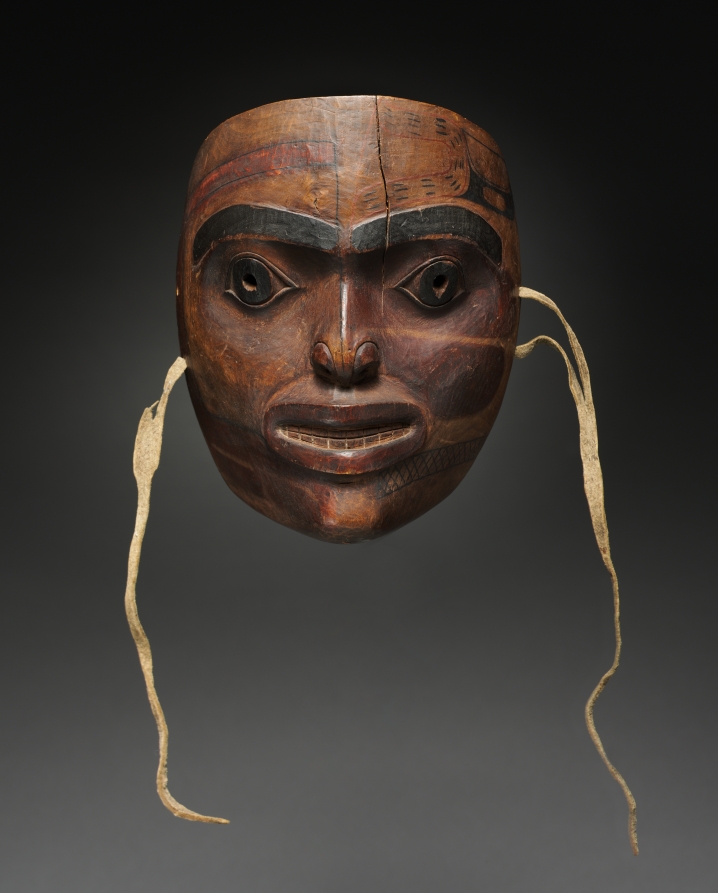
Mask (late 1800s–early 1900s) is in the Cleveland Museum of Art collection.
The work and its context
The museum's open-access catalogue describes the work:
In 1998, Robert Joseph, a Northwest Coast chief, recalled that when he donned ceremonial dance masks as a youth, "all the world is somewhere else . . . I am the mask . . . the bird . . . the animal . . . the spirit. I transcend into the being of the mask." Although this mask's identity is lost, it may represent a mythic ancestor of a Tlingit family and perhaps was worn during a winter ceremony.
Object facts
- Title: Mask
- Date: late 1800s–early 1900s
- Culture: Native North America, Northwest Coast, Alaska, Tlingit
- Type: Sculpture
- Technique: wood (alder), pigment
- Dimensions: Overall: 21.4 x 17.2 x 8.9 cm (8 7/16 x 6 3/4 x 3 1/2 in.)
- Collection: AA - Native North America
- Department: Art of the Americas
- Accession number: 1979.83
Collection credit
Purchase from the J. H. Wade Fund
Further reading listed by the museum
- Lee, Sherman E. "The Year in Review for 1979." The Bulletin of the Cleveland Museum of Art 67, no. 3 (1980): 58-99.
View the collection record
See the museum's photographs and full catalogue entry. Catalogue text is reproduced from the Cleveland Museum of Art's open-access data, with HTML formatting removed. This object and its supplied image are designated CC0.
Sources
More in Lifestyle
Keep reading