Mercury tells Aeneas to Leave Carthage (1679): Art, History and Details
Mercury tells Aeneas to Leave Carthage at the Cleveland Museum of Art: 1679, tapestry weave: silk and wool. Explore the work's context, creator attribution and collection history.
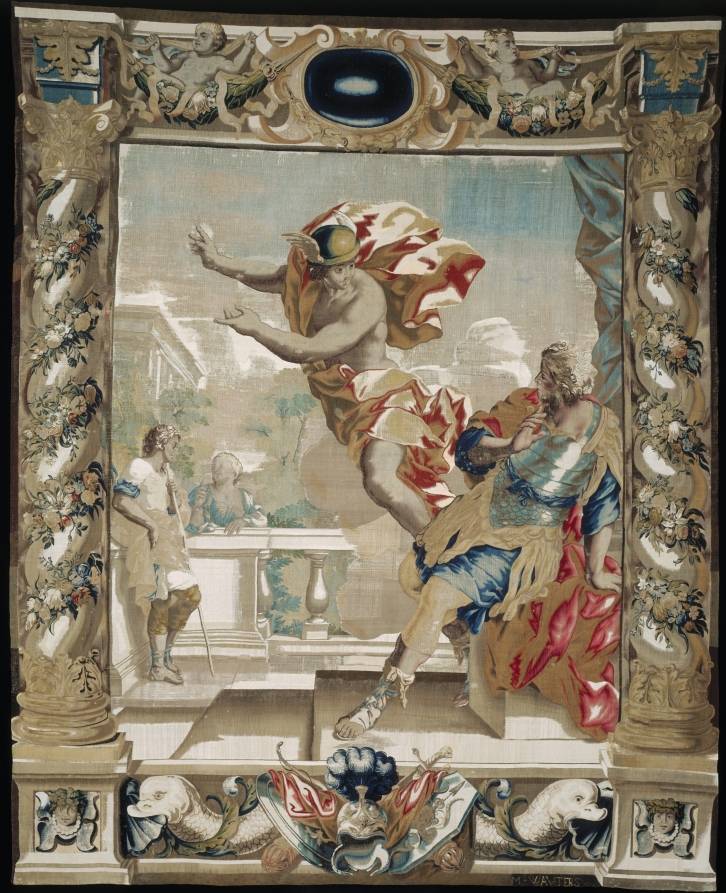
Mercury tells Aeneas to Leave Carthage (1679) is in the Cleveland Museum of Art collection. The museum's creator attribution is Giovanni Francesco Romanelli (Italian, 1610–1662); Michael Wauters (Flemish, 1679).
The work and its context
The museum's open-access catalogue describes the work:
The supreme god, Jupiter, sends his messenger Mercury to the Trojan hero Aeneas to urge him to continue his voyage and leave Carthage in order to fulfil his destiny, to found Rome.
Object facts
- Title: Mercury tells Aeneas to Leave Carthage
- Date: 1679
- Creator attribution: Giovanni Francesco Romanelli (Italian, 1610–1662); Michael Wauters (Flemish, 1679)
- Culture: Belgium, 17th century
- Type: Tapestry
- Technique: tapestry weave: silk and wool
- Dimensions: Overall: 411 x 337 cm (161 13/16 x 132 11/16 in.)
- Collection: Textiles
- Department: Textiles
- Accession number: 1915.79.6
A detail from the museum
This tapestry is one from a series of eight that depicts the tragic love story of Dido and Aeneas. They were gifted to the museum for display in the armor court.
Collection credit
Gift of Mrs. Francis F. Prentiss, in memory of Dr. Dudley P. Allen
Further reading listed by the museum
- W. M. M. "Gothic Art." The Bulletin of the Cleveland Museum of Art 6, no. 4 (1919): 67-70.
- BREMER-DAVID, CHARISSA. "French & Company and American Collections of Tapestries, 1907-1959." Studies in the Decorative Arts 11, no. 1 (2003): 38-68.
- Brosens, Koenraad, and Yvan Maes de Wit. "The Story of Dido and Aeneas from Cleveland Museum of Art: Tapestry conservation Using Laid-Couching Stitches." In Tapestry Production & Conservation: 125 Years De Wit Royal Manufacturers of Tapestry. Koenraad Brosens, Yvan Maes De Wit, 232-235. London; Turnhout: Harvey Miller Publishers, 2019
View the collection record
See the museum's photographs and full catalogue entry. Catalogue text is reproduced from the Cleveland Museum of Art's open-access data, with HTML formatting removed. This object and its supplied image are designated CC0.
Sources
More in Lifestyle
Keep reading
Related stories


