Millefiori Bowl (1–100 CE): Art, History and Details
Millefiori Bowl at the Cleveland Museum of Art: 1–100 CE, glass. Explore the work's context, creator attribution and collection history.
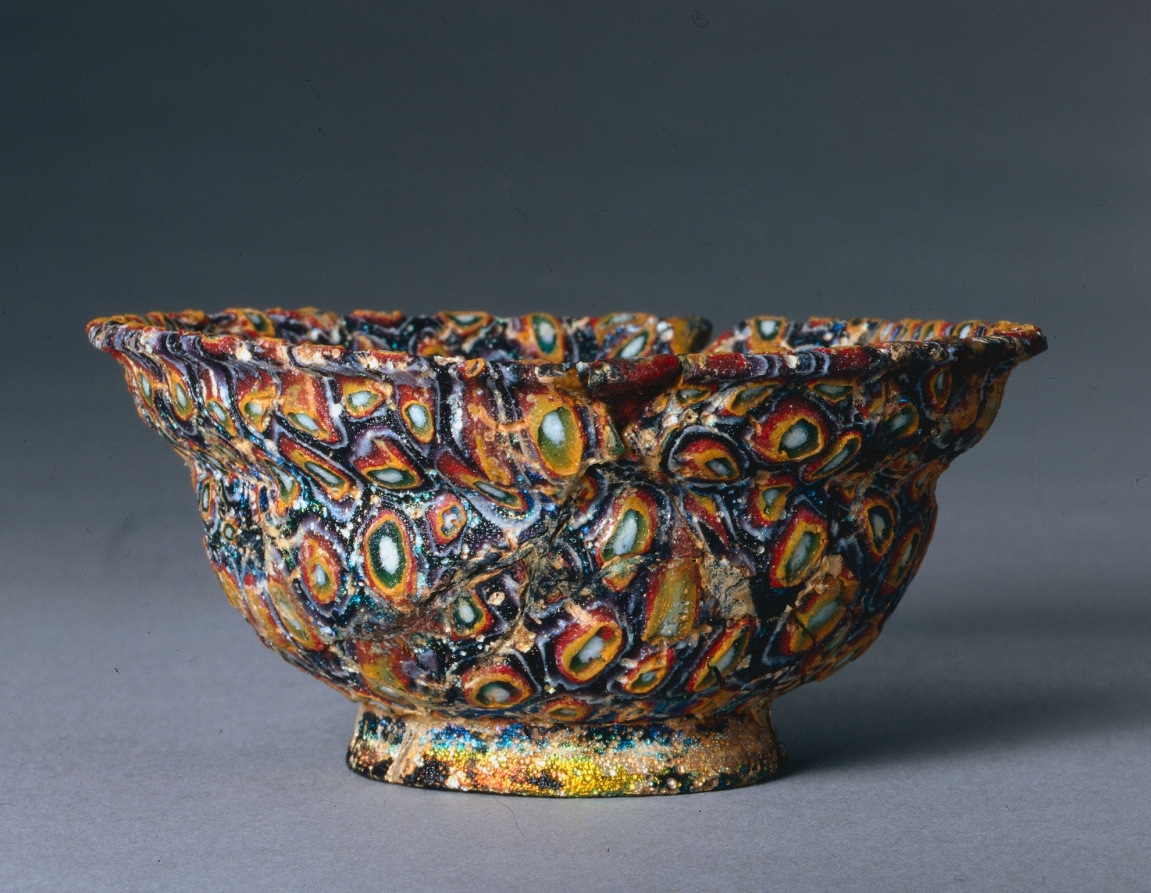
Millefiori Bowl (1–100 CE) is in the Cleveland Museum of Art collection.
The work and its context
The museum's open-access catalogue describes the work:
Mosaic glass, also called millefiori, was cast in a two-part mold. Fused glass rods of different colors were bundled together into patterns, then sliced into disk-shaped cross sections. These were placed within the mold and heated until fused. After cooling, the vessel’s surface was fire- or wheel-polished.
Object facts
- Title: Millefiori Bowl
- Date: 1–100 CE
- Culture: Italy, Roman
- Type: Glass
- Technique: glass
- Dimensions: Overall: 3.8 x 8.8 cm (1 1/2 x 3 7/16 in.); Diameter of foot: 4 cm (1 9/16 in.)
- Collection: GR - Roman
- Department: Greek and Roman Art
- Accession number: 1919.10
A detail from the museum
Millefiori, Italian for “thousand flowers,” describes the ancient glass-making technique later revived by Venetian artisans.
Collection credit
General Income Fund
Further reading listed by the museum
- Anderson Galleries, Inc. New York. Ancient Works of Art....Collected by Azeez Khayat. January 31 - February 1, 1919. Lot 29
- "Accessions." The Bulletin of the Cleveland Museum of Art 6, no. 2 (1919): 37-38.
View the collection record
See the museum's photographs and full catalogue entry. Catalogue text is reproduced from the Cleveland Museum of Art's open-access data, with HTML formatting removed. This object and its supplied image are designated CC0.
Sources
More in Lifestyle
Keep reading