Millefleurs Tapestry with Medici Coat of Arms (1520s): Art, History and Details
Millefleurs Tapestry with Medici Coat of Arms at the Cleveland Museum of Art: 1520s, tapestry weave: wool and silk. Explore the work's context, creator attribution and collection history.
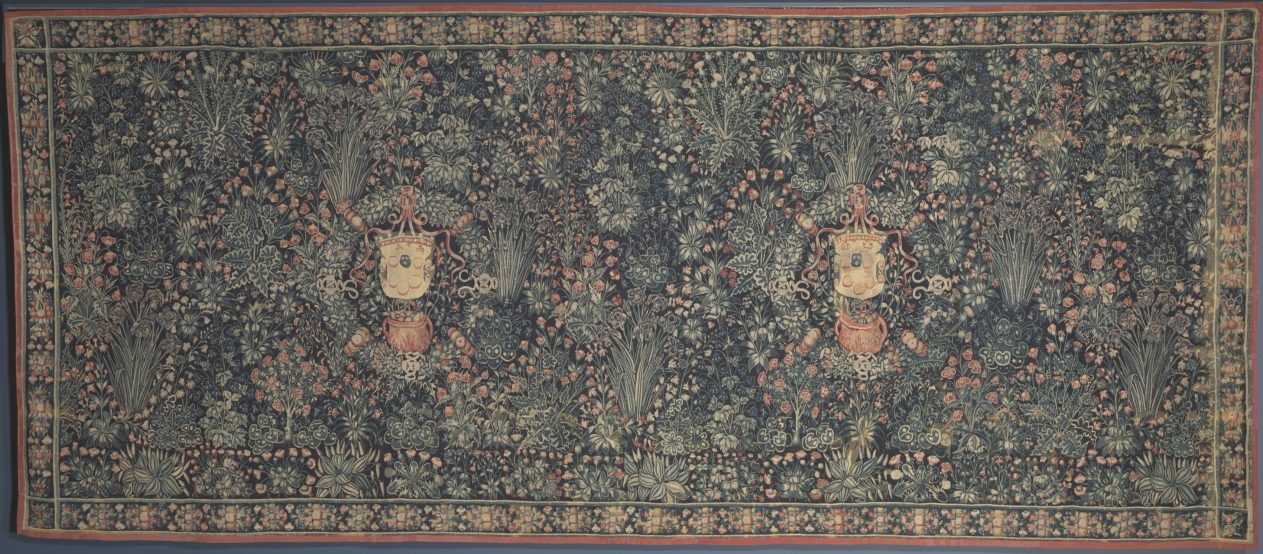
Millefleurs Tapestry with Medici Coat of Arms (1520s) is in the Cleveland Museum of Art collection.
The work and its context
The museum's open-access catalogue describes the work:
Many identifiable flowering plants provide the French name, millefleur, for this pattern, which became fashionable around 1450. Each plant may have symbolized either religion, courtship, or morals. However, many millefleur tapestries, made for about 100 years, were probably not symbolic. Large quantities were woven only with flowers; some also incorporated birds and animals or, in this case, coats of arms. Here, the original coat of arms has been replaced by that of the Medicis, a prominent family in Renaissance Florence.
Object facts
- Title: Millefleurs Tapestry with Medici Coat of Arms
- Date: 1520s
- Culture: Netherlands, Hainault, early 16th century
- Type: Tapestry
- Technique: tapestry weave: wool and silk
- Dimensions: Overall: 274.2 x 652.8 cm (107 15/16 x 257 in.)
- Collection: Textiles
- Department: Textiles
- Accession number: 1942.824
Collection credit
Bequest of John L. Severance
Further reading listed by the museum
- Catalogue of the John L. Severance Collection: Bequest of John L. Severance, 1936. [Cleveland, Ohio]: Cleveland Museum of Art, 1942.
- Milliken, William M. "Bequest of John L. Severance, 1936." The Bulletin of the Cleveland Museum of Art 29, no. 9 (1942): 131.
- Standen, Edith A. "The Carpet of Arms." The Metropolitan Museum of Art Bulletin 20, no. 7 (1962): 221-31.
View the collection record
See the museum's photographs and full catalogue entry. Catalogue text is reproduced from the Cleveland Museum of Art's open-access data, with HTML formatting removed. This object and its supplied image are designated CC0.
Sources
More in Lifestyle
Keep reading