Minamoto no Nakakuni Visits Lady Kogō (late 1600s): Art, History and Details
Minamoto no Nakakuni Visits Lady Kogō at the Cleveland Museum of Art: late 1600s, One of a triptych of hanging scrolls; ink and color on silk. Explore the work's context, creator attribution and collection history.
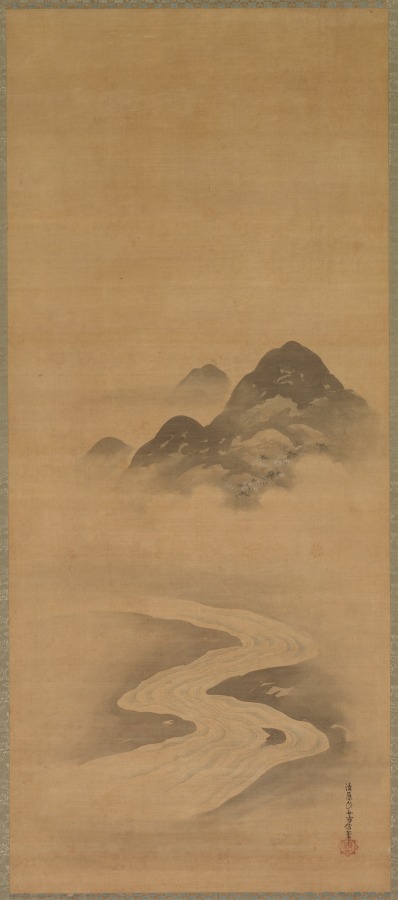
Minamoto no Nakakuni Visits Lady Kogō (late 1600s) is in the Cleveland Museum of Art collection. The museum's creator attribution is Kiyohara Yukinobu (Japanese, 1643–1682).
The work and its context
The museum's open-access catalogue describes the work:
Kiyohara Yukinobu was one of Japan's earliest and most talented female painters. Kiyohara preferred Japanese-style painting techniques and subjects. Her work depicts the scenery and history of her native land. In addition to the tonalities of ink, she applied a delicate range of colors that help identify the seasons, an important theme in Japanese life and culture.
Object facts
- Title: Minamoto no Nakakuni Visits Lady Kogō
- Date: late 1600s
- Creator attribution: Kiyohara Yukinobu (Japanese, 1643–1682)
- Culture: Japan, Edo period (1615–1868)
- Type: Painting
- Technique: One of a triptych of hanging scrolls; ink and color on silk
- Dimensions: Painting only: 95 x 41 cm (37 3/8 x 16 1/8 in.); Including mounting: 180 x 59.4 cm (70 7/8 x 23 3/8 in.)
- Collection: ASIAN - Hanging scroll
- Department: Japanese Art
- Accession number: 1992.77.3
A detail from the museum
This day-lit spring scene is the right part of a triptych presenting an episode from The Tale of the Heike.
Collection credit
Bequest of Harley C. Lee and Elizabeth K. Lee
Further reading listed by the museum
- Turner, Evan H. “The Year in Review for 1992.” The Bulletin of the Cleveland Museum of Art 80, no. 2 (February 1993): 38–79.
View the collection record
See the museum's photographs and full catalogue entry. Catalogue text is reproduced from the Cleveland Museum of Art's open-access data, with HTML formatting removed. This object and its supplied image are designated CC0.
Sources
More in Lifestyle
Keep reading