Mingling of Clear and Muddy Water at the Junction of the Jing and Wei Rivers (1736–95): Art, History and Details
Mingling of Clear and Muddy Water at the Junction of the Jing and Wei Rivers at the Cleveland Museum of Art: 1736–95, Handscroll, silk: tapestry weave; ink and colors; silk: embroidery. Explore the work's context, creator attribution and co
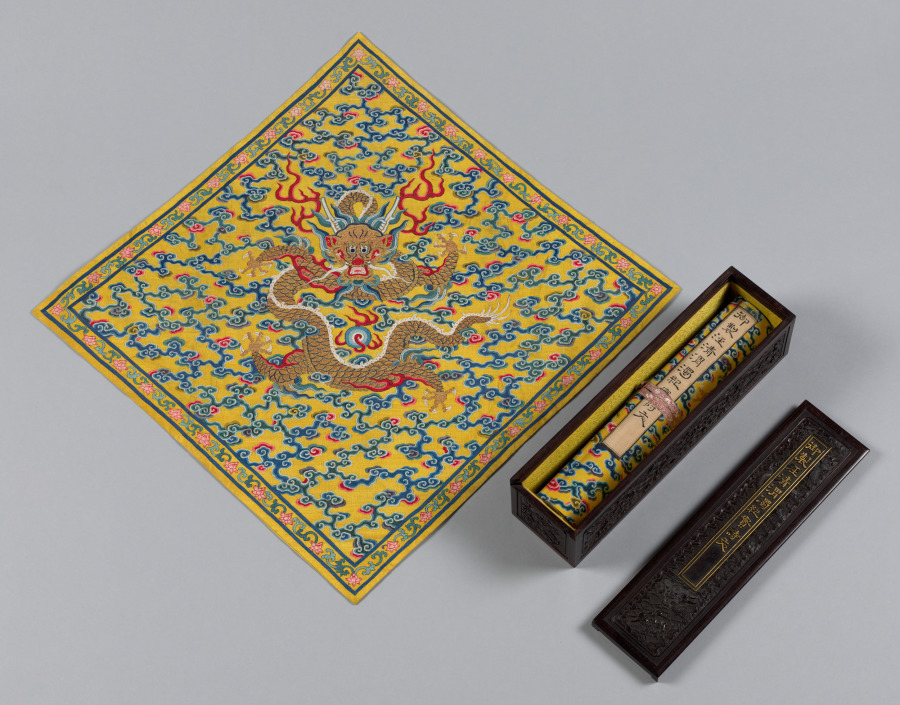
Mingling of Clear and Muddy Water at the Junction of the Jing and Wei Rivers (1736–95) is in the Cleveland Museum of Art collection.
The work and its context
The museum's open-access catalogue describes the work:
This handscroll features a map illustrating the Mingling of Clear and Muddy Water at the Junction of the Jing and Wei Rivers (Jing qing Wei zhuo tu) and a report by the statesman Dong Gao (1704–1818), preceded by an imperial commentary. The entire handscroll is woven in silk; while the calligraphy section on the right side is woven into the fabric, the Chinese characters on the map are all embroidered. The map shows the clear (blue) river Jing in the north joining the muddy (yellow) river Wei in the west and flowing into the large Yellow River in the northeast. The roofs of houses and sections of the city wall in the lower part of the map indicate the city of Xi’an, a former imperial capital in Shaanxi province located near the site where the terracotta soldiers of China’s first emperor were found in modern times. The management and control of the empire’s vast network of waterways, dams, and irrigation systems was an important task for China’s rulers. Flood prevention was essential, for when the Yellow River overflowed it caused disastrous deluges and destroyed farmland and settlements. Here the Qianlong emperor had requested an on-site investigation of the Jing and Wei rivers in order to rectify historic written sources that confused the Jing and Wei rivers. In addition to the Cleveland tapestry scroll, an identical tapestry version is preserved in the Palace Museum in Taipei and a rubbing version on paper is preserved in the National Library in Beijing.
Object facts
- Title: Mingling of Clear and Muddy Water at the Junction of the Jing and Wei Rivers
- Date: 1736–95
- Culture: China, Qing dynasty (1644–1911), Qianlong reign (1736–95)
- Type: Textile
- Technique: Handscroll, silk: tapestry weave; ink and colors; silk: embroidery
- Dimensions: Overall: 273 x 29.6 x 34.5 cm (107 1/2 x 11 5/8 x 13 9/16 in.)
- Collection: Textiles
- Department: Textiles
- Accession number: 1915.618
Collection credit
Gift of the John Huntington Art and Polytechnic Trust
Further reading listed by the museum
- Breeskin, Adelyn Dohme and Charles Crehore Cunningham. 2000 Years of Tapestry Weaving: A Loan Exhibition: Wadsworth Atheneum, Hartford, Dec. 7, 1951 to Jan. 27, 1952; the Baltimore Museum of Art, Feb. 27, 1952 to Mar. 25, 1952. Hartford, CT: Wardsworth Atheneum, 1951.
- Spee, Clarissa von. "From the Silk Road to the Imperial Court: Chinese Textiles in the Cleveland Museum of Art." Arts of Asia 48, no. 3 (May-June 2018): 50–56.
- von Spee, Clarissa. "Clear and Muddy Water: Rediscovering a Chinese imperial tapestry scroll.” Cleveland Art: Cleveland Museum of Art Members Magazine 58. no. 3 (May/June 2018): 14-15.
View the collection record
See the museum's photographs and full catalogue entry. Catalogue text is reproduced from the Cleveland Museum of Art's open-access data, with HTML formatting removed. This object and its supplied image are designated CC0.
Sources
More in Lifestyle
Keep reading