Miniature Votive Stupa (c. 1000s): Art, History and Details
Miniature Votive Stupa at the Cleveland Museum of Art: c. 1000s, bronze with inlay of semiprecious stones. Explore the work's context, creator attribution and collection history.
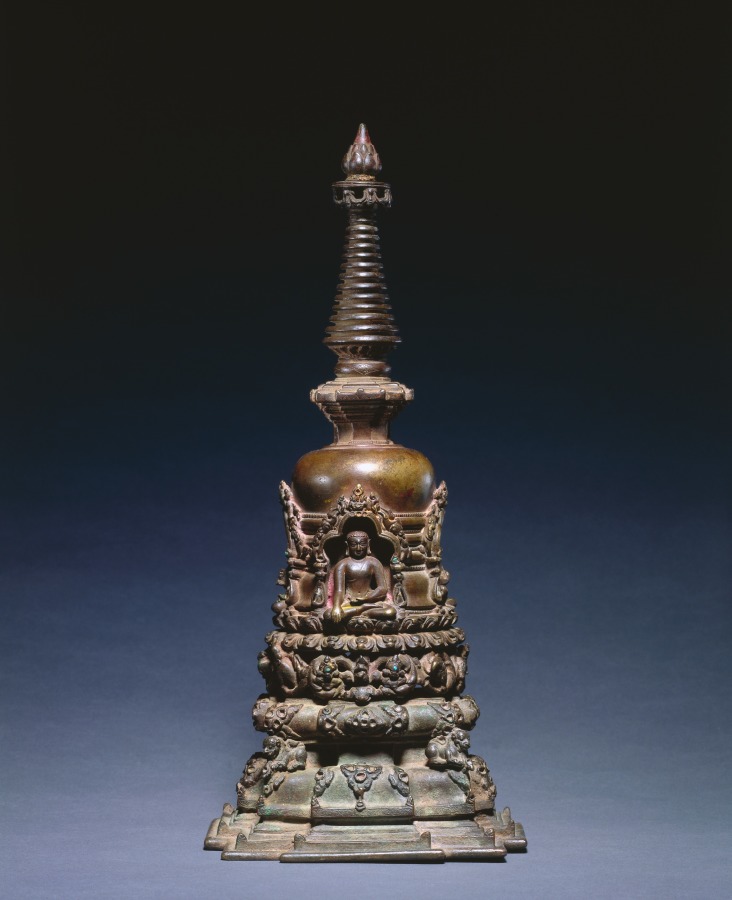
Miniature Votive Stupa (c. 1000s) is in the Cleveland Museum of Art collection.
The work and its context
The museum's open-access catalogue describes the work:
Small-scale stupas were modeled on large monuments that contain relics of the Buddha or revered members of the Buddhist community within the solid, dome segment. Such models were made to commemorate a devotional visit to the monument. Four different sacred Buddhist images face each of the four directions: Shakyamuni, Vajrasattva, Maitreya, and Prajnaparamita.
Object facts
- Title: Miniature Votive Stupa
- Date: c. 1000s
- Culture: Eastern India, Bihar
- Type: Sculpture
- Technique: bronze with inlay of semiprecious stones
- Dimensions: Overall: 29.2 cm (11 1/2 in.)
- Collection: Indian Art
- Department: Indian and Southeast Asian Art
- Accession number: 1982.132
A detail from the museum
The spire consists of thirteen disk-like parasols that refer to the thirteen stages on the path to enlightenment.
Collection credit
John L. Severance Fund
Further reading listed by the museum
- Lee, Sherman E. “Year in Review for 1982.” The Bulletin of the Cleveland Museum of Art, vol. 70, no. 1, 1983, pp. 3–55.
- Huntington, Susan L., and John C. Huntington. Leaves from the Bodhi Tree: The Art of Pāla India (8th-12th Centuries) and Its International Legacy. Dayton, OH: Dayton Art Institute in association with the University of Washington Press, 1990.
- Leidy, Denise Patry, and Robert A. F. Thurman. Mandala: The Architecture of Enlightenment. New York: Asia Society Galleries, 1997.
View the collection record
See the museum's photographs and full catalogue entry. Catalogue text is reproduced from the Cleveland Museum of Art's open-access data, with HTML formatting removed. This object and its supplied image are designated CC0.
Sources
More in Lifestyle
Keep reading