Mirror (918–1392): Art, History and Details
Mirror at the Cleveland Museum of Art: 918–1392, bronze. Explore the work's context, creator attribution and collection history.
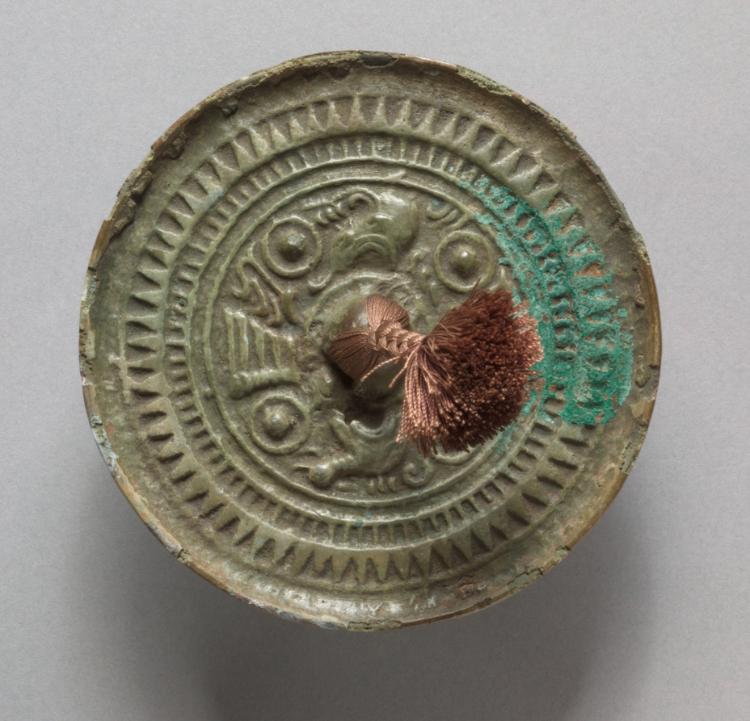
Mirror (918–1392) is in the Cleveland Museum of Art collection.
The work and its context
The museum's open-access catalogue describes the work:
From ancient times, a mirror assumed various roles: a ritualistic tool, a diplomatic gift, and a luxury commodity. During the Goryeo dynasty (918–1392), which saw the great advancement of metallurgy, the royal court was the center of distributing sophisticated bronze artifacts. According to historical records, on the seventhth day of the Lunar New Year, the king bestowed a bronze mirror inscribed with auspicious symbols upon each court official as part of a ceremony to celebrate the Day of Humans. This explains why a large quantity of bronze mirrors were buried in elite tombs.
Object facts
- Title: Mirror
- Date: 918–1392
- Culture: Korea, Goryeo dynasty (918–1392)
- Type: Metalwork
- Technique: bronze
- Dimensions: Diameter: 8.2 cm (3 1/4 in.)
- Collection: Korean Art
- Department: Korean Art
- Accession number: 1917.680
A detail from the museum
Due to its origin as an important tool in religion and politics, mirrors are often mentioned in many Korean proverbs that warn about certain behaviors.
Collection credit
Gift of D. Z. Norton
Further reading listed by the museum
- "Accessions." The Bulletin of the Cleveland Museum of Art 4, no. 4 (1917): 64–67.
- Goryeo Dynasty: Korea's Age of Enlightenment, 918-1392. San Francisco: Asian Art Museum, 2003.
- Choi, Eung-chon. “Craftsmen in Metal Arts in the Goryeo Dynasty [고려시대 金屬工藝의 匠人].” Misulsahak yeongu (2004): 171–192.
View the collection record
See the museum's photographs and full catalogue entry. Catalogue text is reproduced from the Cleveland Museum of Art's open-access data, with HTML formatting removed. This object and its supplied image are designated CC0.
Sources
More in Lifestyle
Keep reading
Related stories