Mirror Case with a Couple Playing Chess (1325–50): Art, History and Details
Mirror Case with a Couple Playing Chess at the Cleveland Museum of Art: 1325–50, ivory. Explore the work's context, creator attribution and collection history.
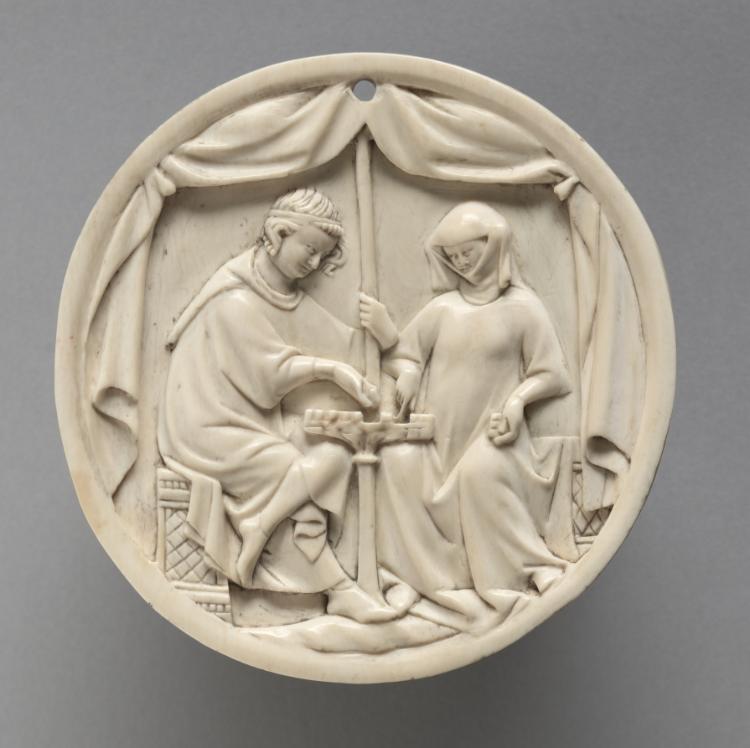
Mirror Case with a Couple Playing Chess (1325–50) is in the Cleveland Museum of Art collection.
The work and its context
The museum's open-access catalogue describes the work:
During the 1300s, elephant ivory was valued by courtly patrons as the most exquisite material for indicating the human form. At this time Paris was the center of production for luxury ivories like the example seen here. They were much sought after by members of the court and aristocracy as emblems of wealth and status and signifiers of fashion and taste. This ivory, once forming a mirror back, depicts a man and woman engaged in a game of chess, a popular game at the time representing both love and war in medieval iconography. Various suggestions have been proposed for the identity of the couple—Tristan and Iseult or Lancelot and Guinevere—without certainty. Mirror backs survive in large numbers from the 1300s and typically depict amorous encounters or chivalrous behavior. They were produced for a secular clientele steeped in romantic literature and with an appetite for luxury objects.
Object facts
- Title: Mirror Case with a Couple Playing Chess
- Date: 1325–50
- Culture: France, Paris
- Type: Ivory
- Technique: ivory
- Dimensions: Diameter: 10.2 x 1 cm (4 x 3/8 in.)
- Collection: MED - Gothic
- Department: Medieval Art
- Accession number: 1940.1200
A detail from the museum
Chess was a wildly popular pastime among the nobility, and was also an important element in medieval romantic literature. Who do you think is winning this game?
Collection credit
Purchase from the J. H. Wade Fund
Further reading listed by the museum
- Longhurst, M.H. "The Eumorfopoulos Collection, Western Objects, II" Apollo 3 (May, 1926).
- Brochard, Maud. “Les ivoires profanes parisiens du XIVe siècle: Artisanat du luxe et objets du quotidien.” In Gothic Ivories between Luxury and Crisis, edited by Manuela Studer-Karlen, pp. 33–55. Schweiz: Schwabe Verlag, 2024.
- Studer-Karlen, Manuela. “Les valves de miroir sculptées sur ivoire et la clientèle féminine.” In Gothic Ivories between Luxury and Crisis, edited by Manuela Studer-Karlen, pp. 203–224. Schweiz: Schwabe Verlag, 2024.
View the collection record
See the museum's photographs and full catalogue entry. Catalogue text is reproduced from the Cleveland Museum of Art's open-access data, with HTML formatting removed. This object and its supplied image are designated CC0.
Sources
More in Lifestyle
Keep reading