Mirror Stand in the Shape of a Djeiran (mid 1600s-early 1900s): Art, History and Details
Mirror Stand in the Shape of a Djeiran at the Cleveland Museum of Art: mid 1600s-early 1900s, bronze. Explore the work's context, creator attribution and collection history.
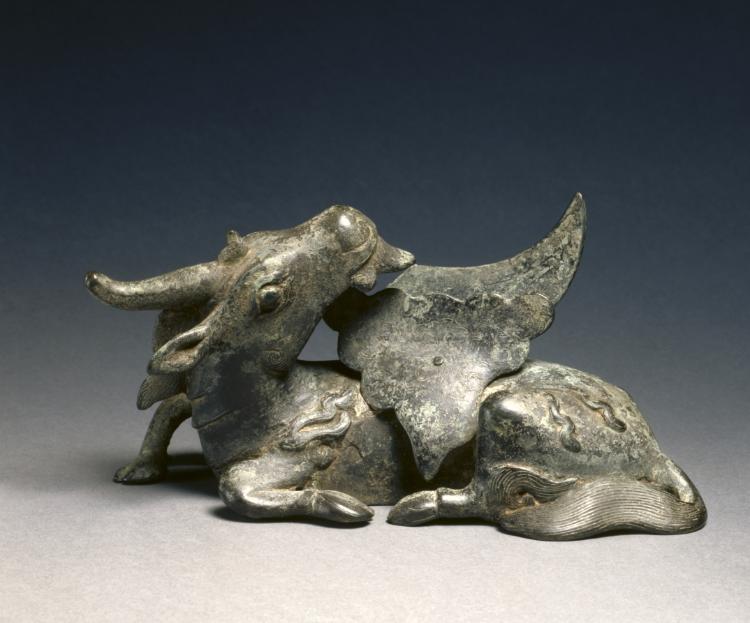
Mirror Stand in the Shape of a Djeiran (mid 1600s-early 1900s) is in the Cleveland Museum of Art collection.
The work and its context
The museum's open-access catalogue describes the work:
This mirror stand is the in shape of a recumbent djeiran, or Central Asian antelope. Commonly appearing on Sogdian silver from the 600s onward, the djeiran motif migrated via the trade routes to northern China. There, during the Jin and Yuan (1279–1368) dynasties, it was very popular and always depicted with the moon supported by clouds. Chinese writers often identify the djeiran as the mythical rhinoceros (xi'niu) that is said to gaze at the moon, or as the cow of Wu "panting upon seeing the moon." When the stand originally held a mirror, the animal would appear to be looking at the moon.
Object facts
- Title: Mirror Stand in the Shape of a Djeiran
- Date: mid 1600s-early 1900s
- Culture: China, Qing dynasty (1644-1911)
- Type: Metalwork
- Technique: bronze
- Dimensions: Overall: 10.6 x 21.2 cm (4 3/16 x 8 3/8 in.)
- Collection: China - Qing Dynasty
- Department: Chinese Art
- Accession number: 1995.385
Collection credit
Gift of Drs. Thomas and Martha Carter in Honor of Sherman E. Lee
Further reading listed by the museum
- Chou, Ju-hsi. Circles of reflection: the Carter collection of Chinese bronze mirrors. Cleveland, OH: The Cleveland Museum of Art, 2000.
View the collection record
See the museum's photographs and full catalogue entry. Catalogue text is reproduced from the Cleveland Museum of Art's open-access data, with HTML formatting removed. This object and its supplied image are designated CC0.
Sources
More in Lifestyle
Keep reading
Related stories