Mirror with Engraved Scene: Man Threatening Child (Telephos and Orestes?) (c. 330–300 BCE): Art, History and Details
Mirror with Engraved Scene: Man Threatening Child (Telephos and Orestes?) at the Cleveland Museum of Art: c. 330–300 BCE, bronze. Explore the work's context, creator attribution and collection history.
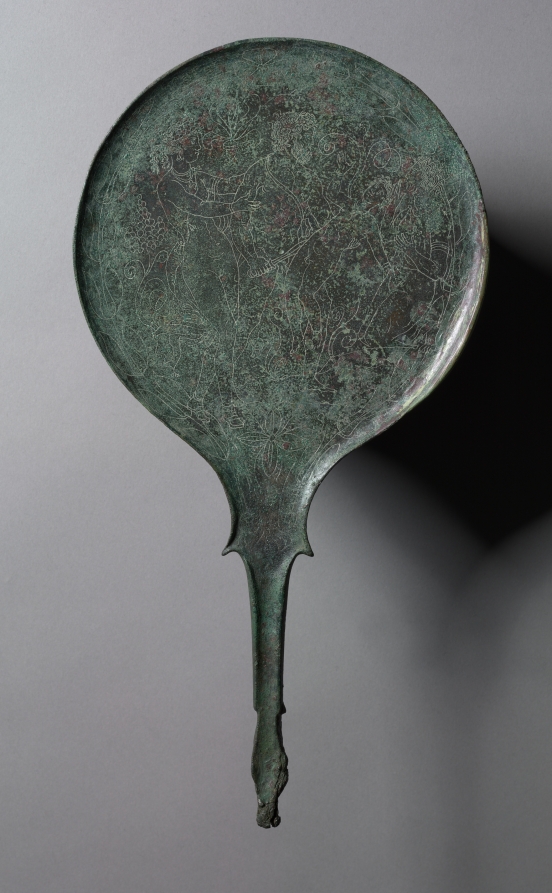
Mirror with Engraved Scene: Man Threatening Child (Telephos and Orestes?) (c. 330–300 BCE) is in the Cleveland Museum of Art collection.
The work and its context
The museum's open-access catalogue describes the work:
Cast in one piece, this bronze mirror features a handle terminating in a stylized deer head. The front side of the disc, once highly polished and reflective, would have served as a mirror, while the reverse—now on display—features an engraved figural scene. Best observed with the aid of a line drawing, this shows a bearded man holding a small child whom he threatens with his sword. Although it lacks inscriptions and certain expected iconographical features, this scene may represent the wounded warrior Telephos holding the young Orestes hostage as he sought a cure for an unhealing wound. The older woman kneeling at right may be the boy's nursemaid, while the nude young woman restraining the man could represent Lasa, an Etruscan nymph-like guardian figure.
Object facts
- Title: Mirror with Engraved Scene: Man Threatening Child (Telephos and Orestes?)
- Date: c. 330–300 BCE
- Culture: Italy, Etruscan, probably Praenestine
- Type: Metalwork
- Technique: bronze
- Dimensions: Overall: 33 cm (13 in.)
- Collection: GR - Etruscan
- Department: Greek and Roman Art
- Accession number: 1920.170
A detail from the museum
The largely unadorned front side of this mirror would have been highly polished and reflective.
Collection credit
Gift of Mrs. John Huntington
Further reading listed by the museum
- "Accessions." The Bulletin of the Cleveland Museum of Art 7, no. 7 (1920): 109-10.
- De Puma, Richard Daniel. "A Fourth Century Praenestine Mirror with Telephos and Orestes." Mitteilungen des Deutschen Archaeologischen Instituts Roemische Abteilung 87 (1980): 5-28.
- De Puma, Richard Daniel. "Greek Myths on Three Etruscan Mirrors in Cleveland." The Bulletin of the Cleveland Museum of Art 70, no. 7 (1983): 290-302.
View the collection record
See the museum's photographs and full catalogue entry. Catalogue text is reproduced from the Cleveland Museum of Art's open-access data, with HTML formatting removed. This object and its supplied image are designated CC0.
Sources
More in Lifestyle
Keep reading