Mirror with Pair of Birds in Chrysanthemum (1392–1573): Art, History and Details
Mirror with Pair of Birds in Chrysanthemum at the Cleveland Museum of Art: 1392–1573, bronze. Explore the work's context, creator attribution and collection history.
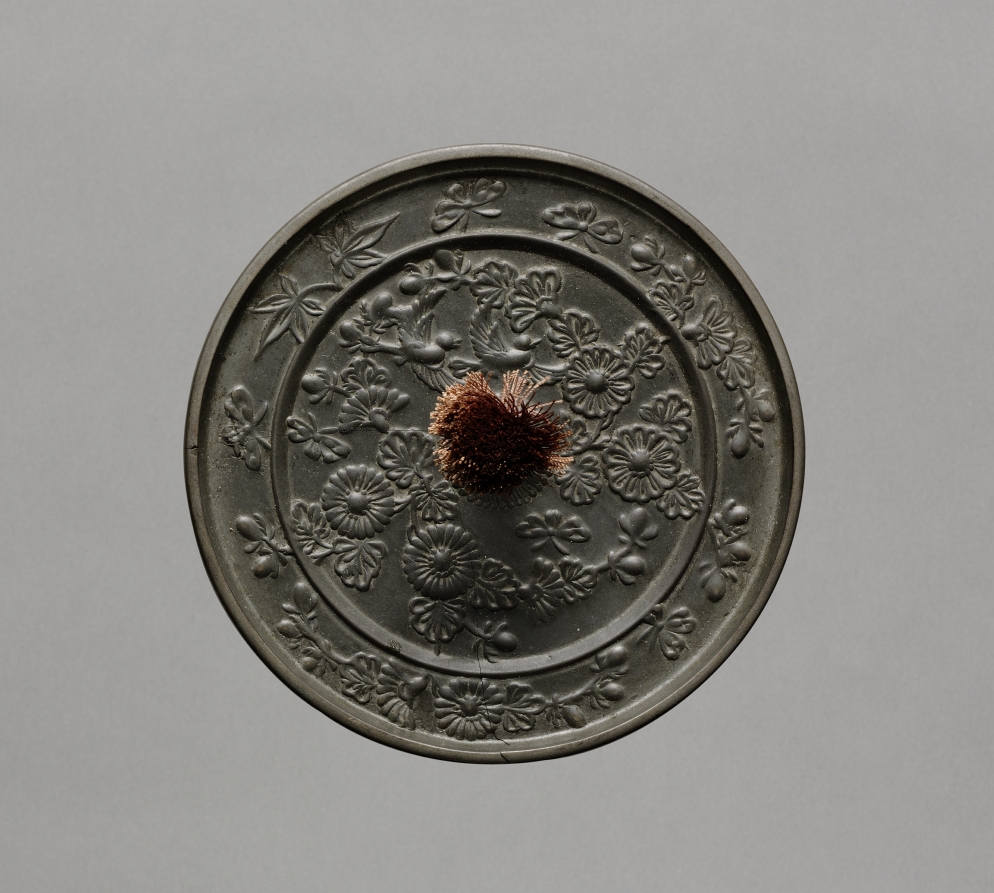
Mirror with Pair of Birds in Chrysanthemum (1392–1573) is in the Cleveland Museum of Art collection.
The work and its context
The museum's open-access catalogue describes the work:
The Japanese used chrysanthemums as decorative elements on mirrors. In the Heian period, a chrysanthemum with cranes or long-tailed birds was a common motif. Later, in the Kamakura and Muromachi periods, chrysanthemum designs were divided into three patterns with different symbolic associations: Chrysanthemum with Cranes represented longevity; Water Flowing suggested longevity as well as the Noh drama Kikujido, or Chrysanthemum Boy; and East Fence alluded to the poem "Drinking Wine" by Tao Yuanming (AD 365–427). Here, the mirror featuring Buddhist iconography (kyojo) and a chrysanthemum design on the back shows that the flower was also appreciated in the context of Buddhism in the Kamakura period.
Object facts
- Title: Mirror with Pair of Birds in Chrysanthemum
- Date: 1392–1573
- Culture: Japan, Muromachi period (1392–1573)
- Type: Metalwork
- Technique: bronze
- Dimensions: Diameter: 11.6 cm (4 9/16 in.)
- Collection: Japanese Art
- Department: Japanese Art
- Accession number: 1917.642
Collection credit
Gift of D. Z. Norton
Further reading listed by the museum
- "Accessions." The Bulletin of the Cleveland Museum of Art 4, no. 4 (1917): 64-67.
- Cleveland Museum of Art, and Sŏn Sŭng-hye. The Lure of Painted Poetry: Japanese and Korean Art. Cleveland: Cleveland Museum of Art, 2011.
View the collection record
See the museum's photographs and full catalogue entry. Catalogue text is reproduced from the Cleveland Museum of Art's open-access data, with HTML formatting removed. This object and its supplied image are designated CC0.
Sources
More in Lifestyle
Keep reading