Mold for a Eulogia (Blessing) Bread (600s-900s): Art, History and Details
Mold for a Eulogia (Blessing) Bread at the Cleveland Museum of Art: 600s-900s, wood. Explore the work's context, creator attribution and collection history.
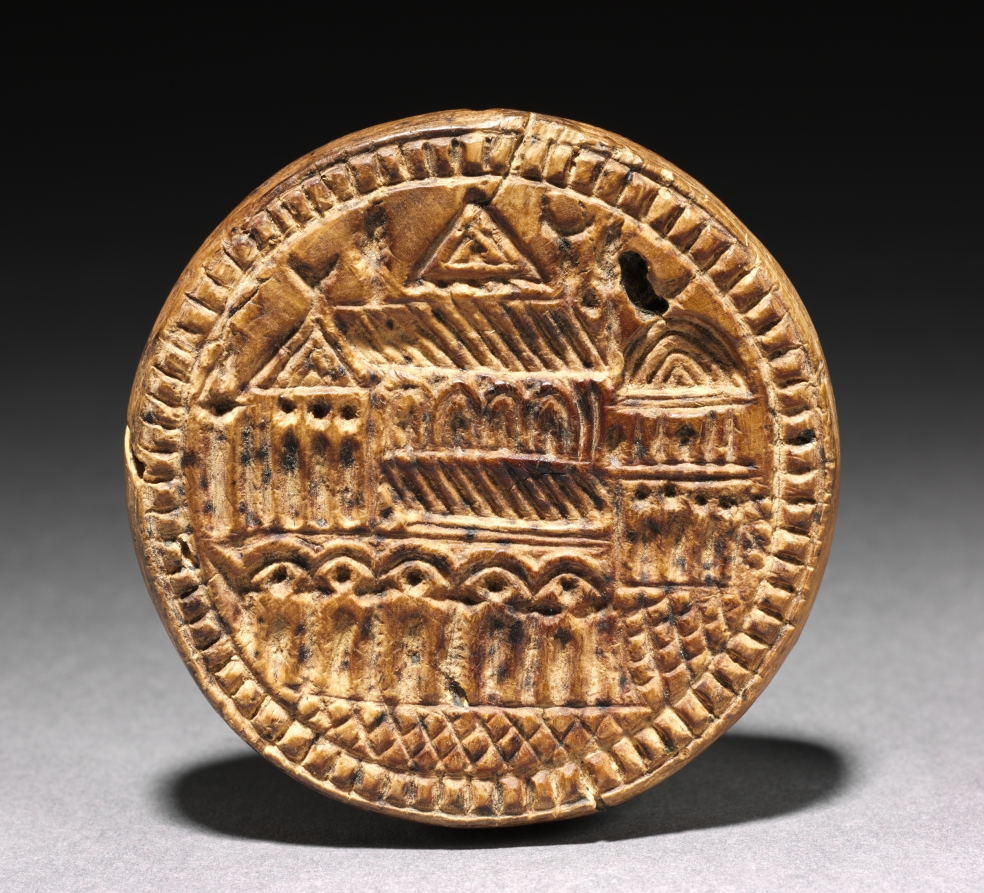
Mold for a Eulogia (Blessing) Bread (600s-900s) is in the Cleveland Museum of Art collection.
The work and its context
The museum's open-access catalogue describes the work:
It was a common early Christian practice to stamp images and inscriptions into loaves of bread using special molds. Representing the Church of the Holy Sepulcher on Mount Golgotha--the hill outside Jerusalem on which Christ was crucified and entombed--this wooden mold was probably used to stamp loaves of bread distributed to pilgrims visiting Jerusalem, in commemoration of their journey.
Object facts
- Title: Mold for a Eulogia (Blessing) Bread
- Date: 600s-900s
- Culture: Byzantium, Palestine, Byzantine period, 7th-10th century
- Type: Sculpture
- Technique: wood
- Dimensions: Diameter: 8.8 x 1.9 cm (3 7/16 x 3/4 in.)
- Collection: MED - Byzantine
- Department: Medieval Art
- Accession number: 1951.152
A detail from the museum
Medieval Christian pilgrims often traveled months or years to religious sites in the Holy Land and returned home with blessed mementos of their journey, such as vials of holy water, relics from saints, and even special loaves of bread. This mold was used to mark bread with an image of the Church of Holy Sepulchre in Jerusalem; the bread was then distributed to pilgrims.
Collection credit
Thirty-fifth anniversary gift of Mr. and Mrs. Paul Mallon
Further reading listed by the museum
- Wessel, Klaus, Marcell Restle, Birgitt Borkopp-Restle, Annegret Plontke-Lüning, and Andreas Pülz. Reallexikon zur byzantinischen Kunst. 1966.
- Galavaris, George. Bread and the Liturgy: The Symbolism of Early Christian and Byzantine Bread Stamps. 1970.
- Krautheimer, Richard, and Slobodan Ćurčić. Early Christian and Byzantine Architecture. Harmondsworth, Middlesex, Eng: Penguin Books, 1986.
View the collection record
See the museum's photographs and full catalogue entry. Catalogue text is reproduced from the Cleveland Museum of Art's open-access data, with HTML formatting removed. This object and its supplied image are designated CC0.
Sources
More in Lifestyle
Keep reading