Monju as a Child (1400s–1500s): Art, History and Details
Monju as a Child at the Cleveland Museum of Art: 1400s–1500s, hanging scroll; ink and color on silk. Explore the work's context, creator attribution and collection history.
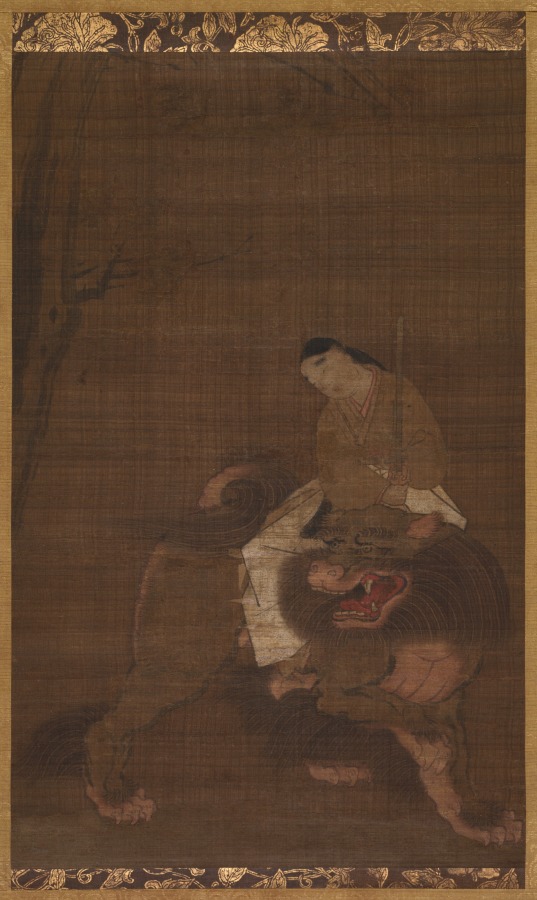
Monju as a Child (1400s–1500s) is in the Cleveland Museum of Art collection.
The work and its context
The museum's open-access catalogue describes the work:
In this work, a young boy dressed in Japanese court costume holds a sword and sacred text, symbols of wisdom carried by the bodhisattva Monju, and rides a lion, also associated with that Buddhist deity. As boy and lion pass beneath a sketchily inked tree, the lion pauses, right foreleg suspended in midair, and the pair looks back. The relatively naturalist posing and sensibility of the painting, as well as the boy’s attire, suggest the possibility that he is a manifestation of a Wakamiya, a youthful kami (a Japanese deity), whose Buddhist counterpart is Monju.
Object facts
- Title: Monju as a Child
- Date: 1400s–1500s
- Culture: Japan, Muromachi period (1392–1573)
- Type: Painting
- Technique: hanging scroll; ink and color on silk
- Dimensions: Overall: 61.7 x 38.7 cm (24 5/16 x 15 1/4 in.)
- Collection: ASIAN - Hanging scroll
- Department: Japanese Art
- Accession number: 1992.385
Collection credit
Bequest of Maud Eells Corning
View the collection record
See the museum's photographs and full catalogue entry. Catalogue text is reproduced from the Cleveland Museum of Art's open-access data, with HTML formatting removed. This object and its supplied image are designated CC0.
Sources
More in Lifestyle
Keep reading