Monk bearing offerings (c. 300 CE): Art, History and Details
Monk bearing offerings at the Cleveland Museum of Art: c. 300 CE, stucco. Explore the work's context, creator attribution and collection history.
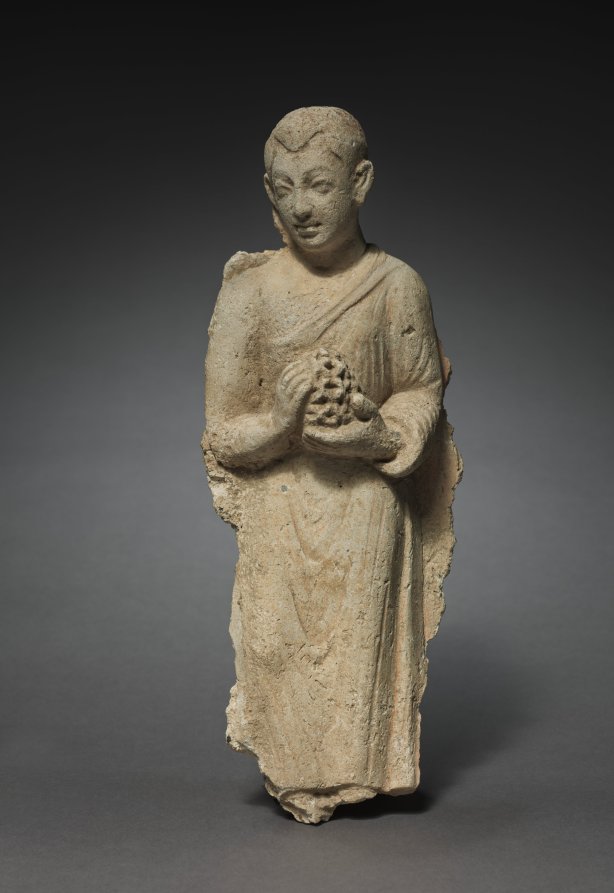
Monk bearing offerings (c. 300 CE) is in the Cleveland Museum of Art collection.
The work and its context
The museum's open-access catalogue describes the work:
This Buddhist monk wears a robe over one shoulder, and his hair has been shaved. He reverently brings offerings of fruit or flowers to the Buddha. Triads depicting the Buddha with attendants bringing offerings were set up on the base of monuments called stupas, in niches defined by pilasters with Corinthian-style columns indicative of the region's Hellenistic heritage.
Object facts
- Title: Monk bearing offerings
- Date: c. 300 CE
- Culture: Afghanistan, Hadda, probably Tape Shotor
- Type: Sculpture
- Technique: stucco
- Dimensions: Overall: 27.3 x 10.3 x 5.4 cm (10 3/4 x 4 1/16 x 2 1/8 in.)
- Collection: Indian Art - Kushan, Gandhara
- Department: Indian and Southeast Asian Art
- Accession number: 1967.41
A detail from the museum
This sculpture came from a monastery famous for preserving pieces of the Buddha's skull and robe.
Collection credit
Edward L. Whittemore Fund
Further reading listed by the museum
- "Year in Review." The Bulletin of the Cleveland Museum of Art 54, no. 10 (December 1967): 302–347.
- Haesner, Chhaya. "A Cultural Diffusion" in India and Greece, Connections and Parallels. Saryu Doshi, ed. Bombay: Marg Publications, 1985.
- Czuma, Stanislaw J., and Rekha Morris. Kushan Sculpture: Images from Early India. Cleveland, OH: The Cleveland Museum of Art in cooperation with Indiana University Press, 1985.
View the collection record
See the museum's photographs and full catalogue entry. Catalogue text is reproduced from the Cleveland Museum of Art's open-access data, with HTML formatting removed. This object and its supplied image are designated CC0.
Sources
More in Lifestyle
Keep reading