Monkey (possibly 1700s): Art, History and Details
Monkey at the Cleveland Museum of Art: possibly 1700s, wood. Explore the work's context, creator attribution and collection history.
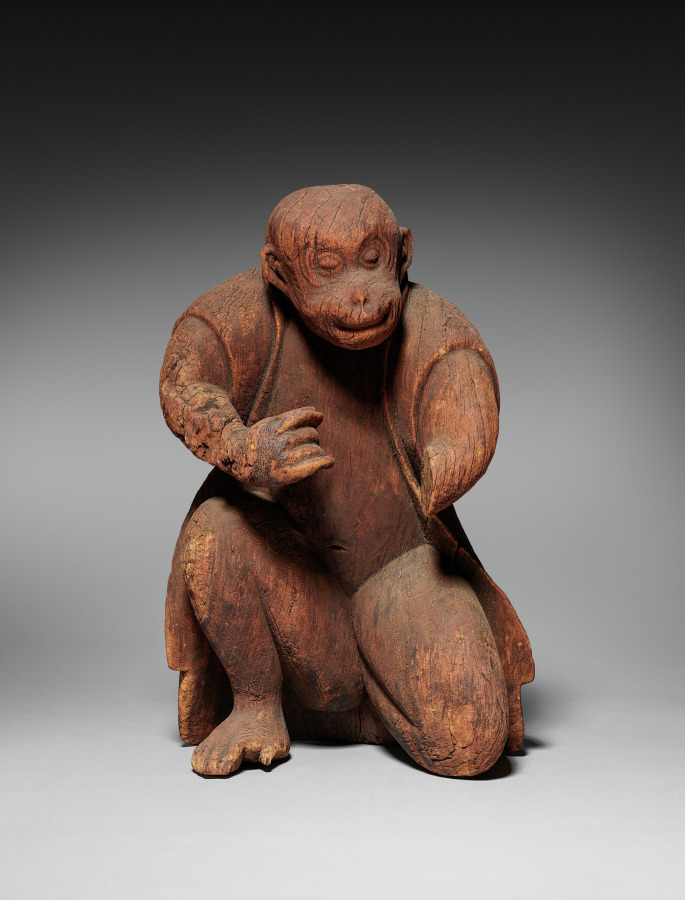
Monkey (possibly 1700s) is in the Cleveland Museum of Art collection.
The work and its context
The museum's open-access catalogue describes the work:
Watching monkeys perform was once a popular form of street entertainment in Japan. Monkeys were outfitted with costumes and learned to perform dances and tricks. Monkeys also serve as the messengers of certain kami, or deities, and pairs of clothed monkey sculptures in wood or stone may be found on either side of the entrance of some jinja, or shrines dedicated to kami. This monkey has a jacket and may have once held bells and a fan. Unfortunately, its original identity and purpose have been lost.
Object facts
- Title: Monkey
- Date: possibly 1700s
- Culture: Japan, Edo period (1615–1868)
- Type: Sculpture
- Technique: wood
- Dimensions: Overall: 55.3 cm (21 3/4 in.)
- Collection: Japanese Art
- Department: Japanese Art
- Accession number: 1924.350
Collection credit
Dudley P. Allen Fund
Further reading listed by the museum
- Catalogue of the Inaugural Exhibition June 6-September 20, 1916. Cleveland, OH: The Cleveland Museum of Art, 1916.
- Sizer, Theodore. "A Note on the Japanese Collection." The Bulletin of the Cleveland Museum of Art 11, no. 9 (November 1924): 174–175, and 187.
- The Cleveland Museum of Art. Art of the Seaway Nations. Cleveland, OH: East Ohio Gas Co., 1959.
View the collection record
See the museum's photographs and full catalogue entry. Catalogue text is reproduced from the Cleveland Museum of Art's open-access data, with HTML formatting removed. This object and its supplied image are designated CC0.
Sources
More in Lifestyle
Keep reading