Monolithic Pillar (600s–700s): Art, History and Details
Monolithic Pillar at the Cleveland Museum of Art: 600s–700s, red sandstone. Explore the work's context, creator attribution and collection history.
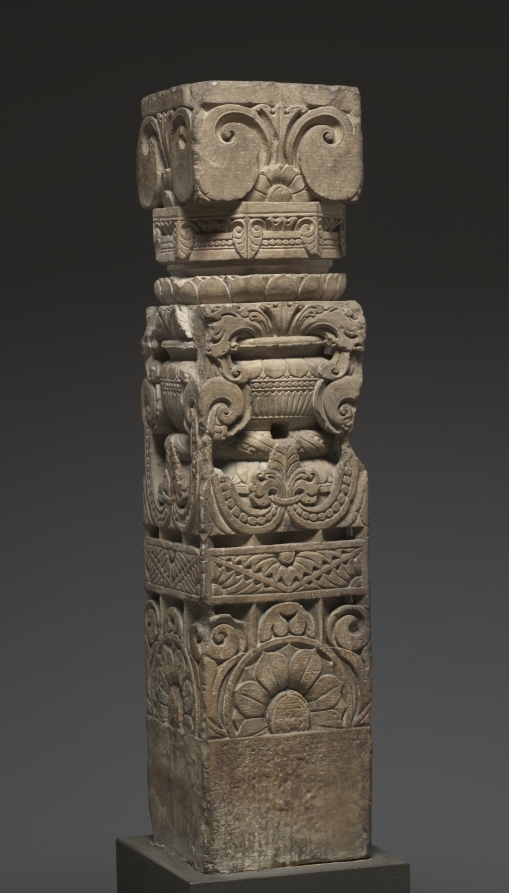
Monolithic Pillar (600s–700s) is in the Cleveland Museum of Art collection.
The work and its context
The museum's open-access catalogue describes the work:
The central motif of this temple pillar is a pot, out of which vegetal forms exuberantly emerge, indicating bounty and abundance. The pot itself is decorated with lotus petals, leaves, and a band of pearls. The overflowing pot is a pervasive symbol in India to reference the prosperity and productivity that will result from worship and prayers at the holy site. It also symbolizes the auspiciousness and beauty of the created world.
Object facts
- Title: Monolithic Pillar
- Date: 600s–700s
- Culture: Northern India, Mathura, early medieval period, 7th-8th century
- Type: Sculpture
- Technique: red sandstone
- Dimensions: Overall: 109.9 x 25.4 cm (43 1/4 x 10 in.)
- Collection: Indian Art
- Department: Indian and Southeast Asian Art
- Accession number: 1938.14
Collection credit
Edward L. Whittemore Fund
Further reading listed by the museum
- Hollis, Howard. "An Indian Pillar." The Bulletin of the Cleveland Museum of Art 26, no. 1 (January 1939): 5–6.
- The Cleveland Museum of Art. The Cleveland Museum of Art Handbook. Cleveland, OH: The Cleveland Museum of Art, 1958.
- Czuma, Stanislaw. “Mathura Sculpture in the Cleveland Museum Collection.” The Bulletin of the Cleveland Museum of Art, vol. 64, no. 3, 1977, pp. 83–114.
View the collection record
See the museum's photographs and full catalogue entry. Catalogue text is reproduced from the Cleveland Museum of Art's open-access data, with HTML formatting removed. This object and its supplied image are designated CC0.
Sources
More in Lifestyle
Keep reading