Monster Caryatid (late 500s): Art, History and Details
Monster Caryatid at the Cleveland Museum of Art: late 500s, Limestone. Explore the work's context, creator attribution and collection history.
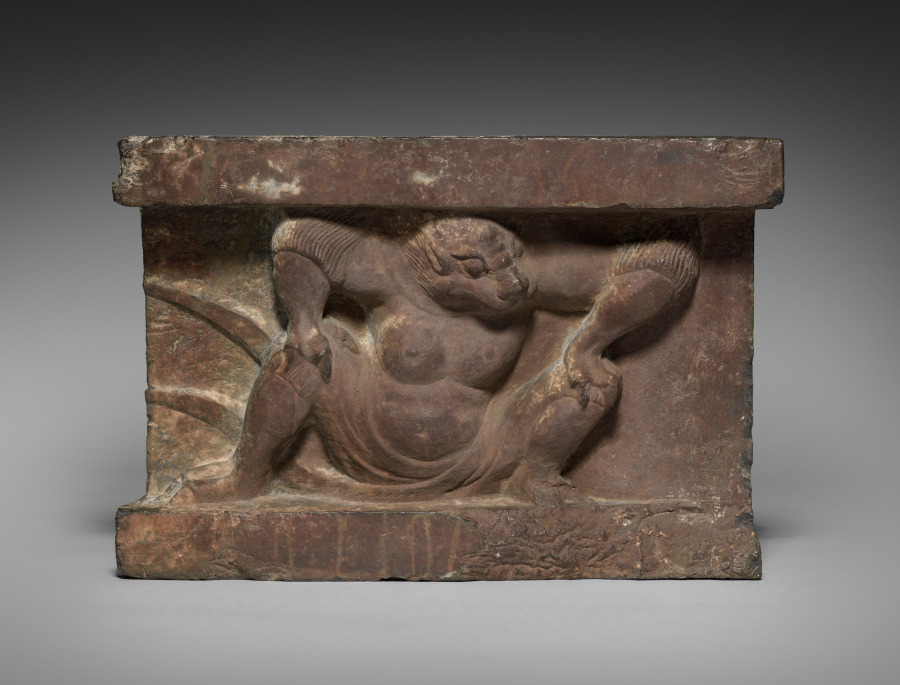
Monster Caryatid (late 500s) is in the Cleveland Museum of Art collection.
The work and its context
The museum's open-access catalogue describes the work:
This squatting monster with claws on its knees, braces its shoulders against an overhanging molding. The half-human, half-animal creature was likely part of a Buddhist cave-temple complex at Xiangtangshan, in Hebei Province, northwest China. Found in the lower registers of stone monuments of either architectural structures or statues of Buddhist deities, such monsters had a supportive function. Their scary appearance was believed to keep evil spirits away from the sacred sites.
Object facts
- Title: Monster Caryatid
- Date: late 500s
- Culture: China, possibly from Xiangtangshan, Northern Qi dynasty (550–577)
- Type: Sculpture
- Technique: Limestone
- Dimensions: Overall: 28 x 40 cm (11 x 15 3/4 in.)
- Collection: China - Southern Dynasties
- Department: Chinese Art
- Accession number: 1957.357
A detail from the museum
The complex of Buddhist cave temples at Xiangtangshan, “Mountain of Echoing Halls,” is a central achievement of the Northern Qi period.
Collection credit
Anonymous Gift
Further reading listed by the museum
- Weisberg, Gabriel P. and H. W. Janson. Traditions and Revisions: Themes from the History of Sculpture. Cleveland, OH: The Cleveland Museum of Art, 1975.
- Watson, William. L'art de l'ancienne Chine. Paris: Mazenod, 1979.
- Xu, Jin. "Monsters on an Imperial Stone Base: Reconstructing Seven Stone Panels from Xiangtangshan." Orientations 55, no. 1 (January/February 2024): 12–20.
View the collection record
See the museum's photographs and full catalogue entry. Catalogue text is reproduced from the Cleveland Museum of Art's open-access data, with HTML formatting removed. This object and its supplied image are designated CC0.
Sources
More in Lifestyle
Keep reading
Related stories
![Single Leaf from a Decretum by Gratian: Decorated Initial Q[uidam habens filium obtulit] and Quadruple Arcade with Concordance of Greek and Latin Alphabets (c. 1160–1165; Cleveland 1954.598)](https://openaccess-cdn.clevelandart.org/1954.598/1954.598_web.jpg)