Mortuary Figures of the Zodiac Signs (500s): Art, History and Details
Mortuary Figures of the Zodiac Signs at the Cleveland Museum of Art: 500s, gray earthenware with traces of slip. Explore the work's context, creator attribution and collection history.
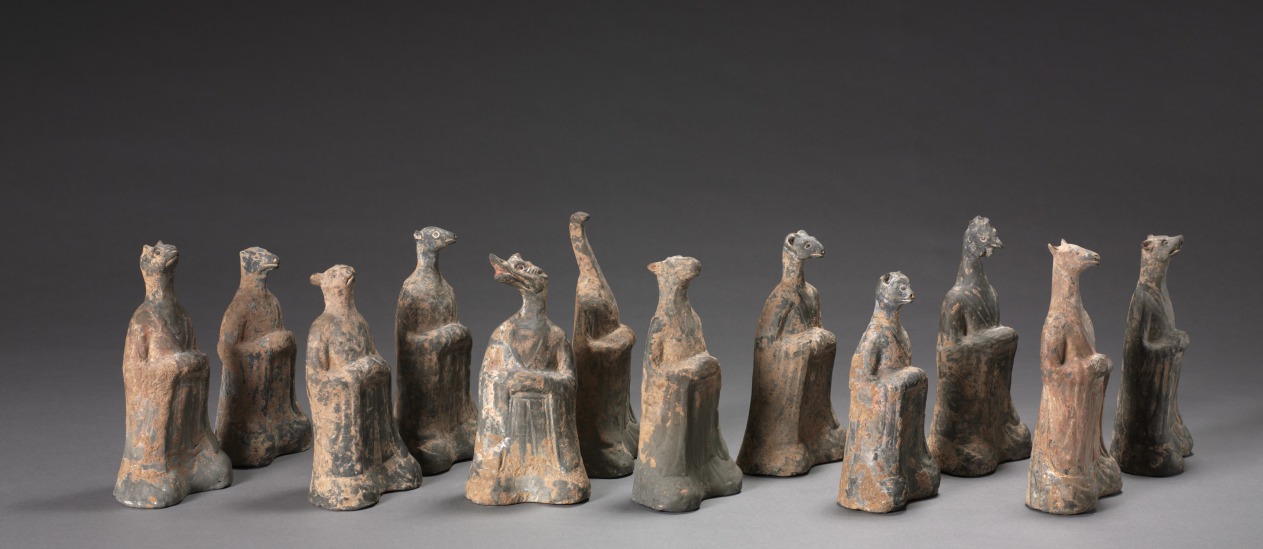
Mortuary Figures of the Zodiac Signs (500s) is in the Cleveland Museum of Art collection.
The work and its context
The museum's open-access catalogue describes the work:
The twelve-animal zodiac series—rat, ox, tiger, rabbit, dragon, snake, horse, goat, monkey, rooster, dog, and boar—signifies a traditional Chinese concept of time structured in a cyclical order. The twelve animals are also linked to the art of fortune-telling that underlies human existence in connection with the changes of the universe. The use of the twelve zodiac animals as tomb furniture suggests they provided a cosmological structure for the afterlife.
Object facts
- Title: Mortuary Figures of the Zodiac Signs
- Date: 500s
- Culture: China, Northern Wei dynasty (386–534 CE)
- Type: Sculpture
- Technique: gray earthenware with traces of slip
- Dimensions: Overall: 22.6 cm (8 7/8 in.)
- Collection: China - Northern Dynasties
- Department: Chinese Art
- Accession number: 1972.76
A detail from the museum
These earthenware mortuary figures appear to have been made in molds.
Collection credit
The Norweb Collection
Further reading listed by the museum
- Weisberg, Gabriel P. and H. W. Janson. Traditions and Revisions: Themes from the History of Sculpture. Cleveland, Kent, Ohio: The Cleveland Museum of Art; Distributed by the Kent State University Press, 1975.
- Wilson, J. Keith. "Powerful Form and Potent Symbol: The Dragon in Asia." The Bulletin of the Cleveland Museum of Art 77, no. 8 (October 1990): 286–323.
- Delacour, Catherine. La Voie du Tao: Un Autre Chemin de l'Etre: Galeries Nationales, Grand Palais, 29 Mars-5 Juillet, 2010. Paris: Réunion des Musées Nationaux: Musée Guimet, 2010.
View the collection record
See the museum's photographs and full catalogue entry. Catalogue text is reproduced from the Cleveland Museum of Art's open-access data, with HTML formatting removed. This object and its supplied image are designated CC0.
Sources
More in Lifestyle
Keep reading