Mosaic of Tigress and Cubs (300s CE): Art, History and Details
Mosaic of Tigress and Cubs at the Cleveland Museum of Art: 300s CE, tesserae. Explore the work's context, creator attribution and collection history.
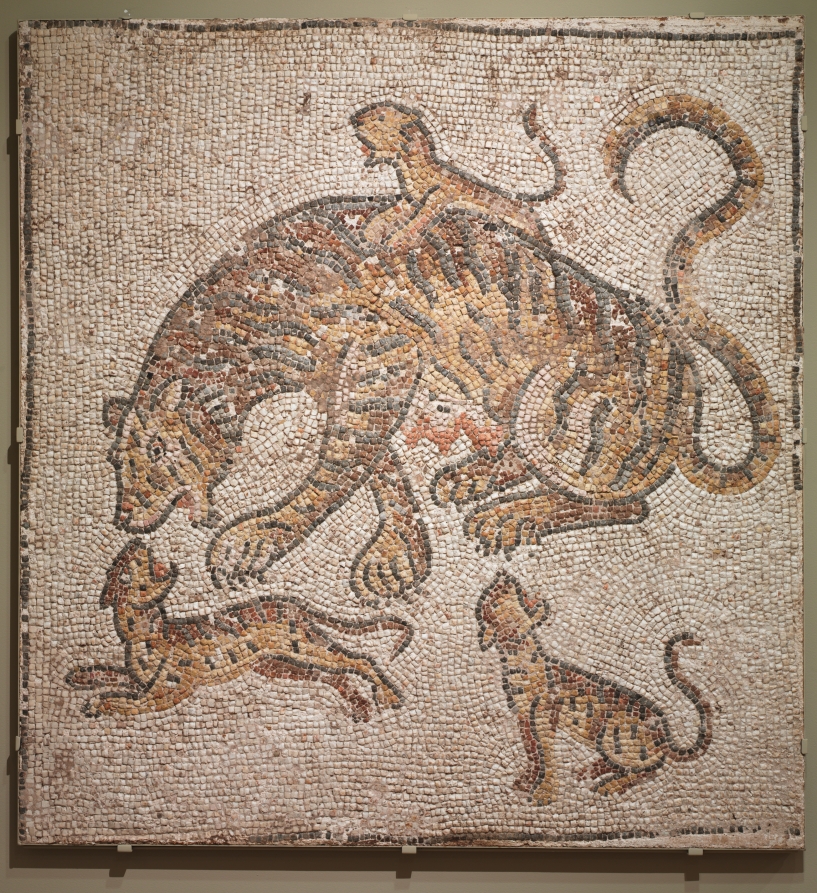
Mosaic of Tigress and Cubs (300s CE) is in the Cleveland Museum of Art collection.
The work and its context
The museum's open-access catalogue describes the work:
Despite its rectangular shape and creation from mostly square tesserae, this mosaic incorporates many curves in its composition, particularly for the tails of the tigers. With one cub on her back and two before her, the mother tiger reaches out with one paw and an open mouth, whether to scold or to play. Unlike lions, leopards, and bears, tigers appear relatively rarely in Roman art, with the tigress seen more frequently than her male counterpart.
Object facts
- Title: Mosaic of Tigress and Cubs
- Date: 300s CE
- Culture: Eastern Roman Empire
- Type: Mosaic
- Technique: tesserae
- Dimensions: Overall: 142.9 x 135.4 cm (56 1/4 x 53 5/16 in.)
- Collection: GR - Roman
- Department: Greek and Roman Art
- Accession number: 1987.65
A detail from the museum
This mosaic includes over ten thousand tesserae, or small cut-stone tiles.
Collection credit
John L. Severance Fund
Further reading listed by the museum
- Turner, Evan H. "The Year in Review for 1987." The Bulletin of the Cleveland Museum of Art 75, no. 2 (1988): 30-71.
- Cleveland Museum of Art. Handbook of the Cleveland Museum of Art. Cleveland, Ohio: The Museum, 1991.
- Cleveland Museum of Art. Motherhood across Time. Cleveland: Cleveland Museum of Art, 2021.
View the collection record
See the museum's photographs and full catalogue entry. Catalogue text is reproduced from the Cleveland Museum of Art's open-access data, with HTML formatting removed. This object and its supplied image are designated CC0.
Sources
More in Lifestyle
Keep reading