Mother-and-Child Figure (late 1800s–early 1900s): Art, History and Details
Mother-and-Child Figure at the Cleveland Museum of Art: late 1800s–early 1900s, Wood, glass beads, upholstery studs, natural fiber, and pigment. Explore the work's context, creator attribution and collection history.
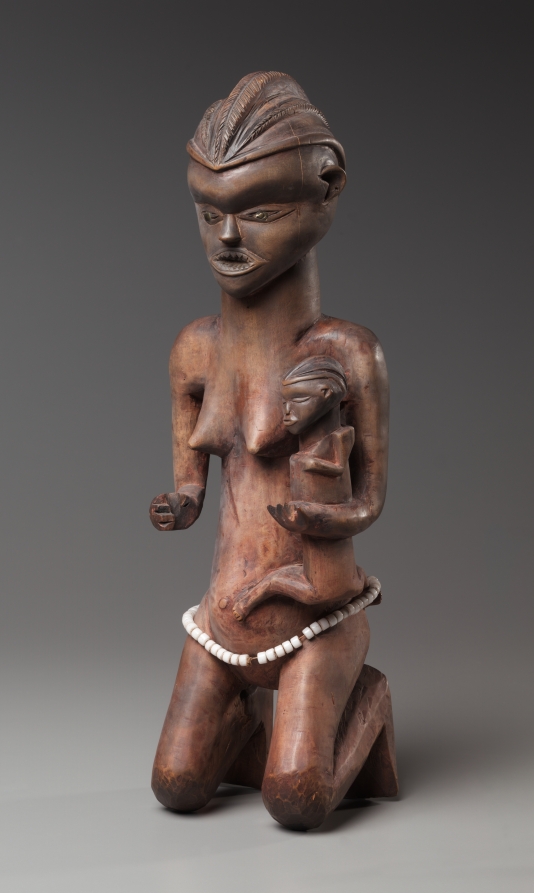
Mother-and-Child Figure (late 1800s–early 1900s) is in the Cleveland Museum of Art collection.
The work and its context
The museum's open-access catalogue describes the work:
Wearing an elaborate lobed headdress and a beaded waistbelt, and having filed teeth and red-powdered skin, this maternity figure seems to have once carried an ax and a cup, wooden imitations of the two most important chiefly attributes. Perhaps together with a male counterpart, it was secretly kept inside the ritual house, serving as a guardian of the chief’s treasure. Its style places it in the westernmost corner of Pendeland, between the Lutshima and Kwilu rivers.
Object facts
- Title: Mother-and-Child Figure
- Date: late 1800s–early 1900s
- Culture: Africa, Central Africa, Democratic Republic of Congo, Pende-style maker
- Type: Sculpture
- Technique: Wood, glass beads, upholstery studs, natural fiber, and pigment
- Dimensions: Overall: 53.4 x 13.1 x 14.6 cm (21 x 5 3/16 x 5 3/4 in.)
- Collection: African Art
- Department: African Art
- Accession number: 1931.426
A detail from the museum
Eastern Pende carvers also once made larger mother-and-child sculptures to adorn the tops of chiefs' ritual houses.
Collection credit
Gift of the African Art Sponsors of Karamu House
Further reading listed by the museum
- Wixom, William D. "African Art in the Cleveland Museum of Art." African Arts 10, no. 3 (1977): 16-25, 88, pp. 16-24, repr., fig. 10 (center).
- "Three Pieces of Negro Sculpture." The Bulletin of the Cleveland Museum of Art 19, no. 3 (March 1932): 38-39.
- Petridis, Constantine. “Mbala, Tsaam, or Kwilu Pende? A Mother-and-Child Figure from the Kwango-Kwilu Region of the Democratic Republic of the Congo.” Cleveland Studies in the History of Art 7 (2002): 126–141.
View the collection record
See the museum's photographs and full catalogue entry. Catalogue text is reproduced from the Cleveland Museum of Art's open-access data, with HTML formatting removed. This object and its supplied image are designated CC0.
Sources
More in Lifestyle
Keep reading