Mountain Market, Clear with Rising Mist (early 1500s): Art, History and Details
Mountain Market, Clear with Rising Mist at the Cleveland Museum of Art: early 1500s, Hanging scroll; ink on silk. Explore the work's context, creator attribution and collection history.
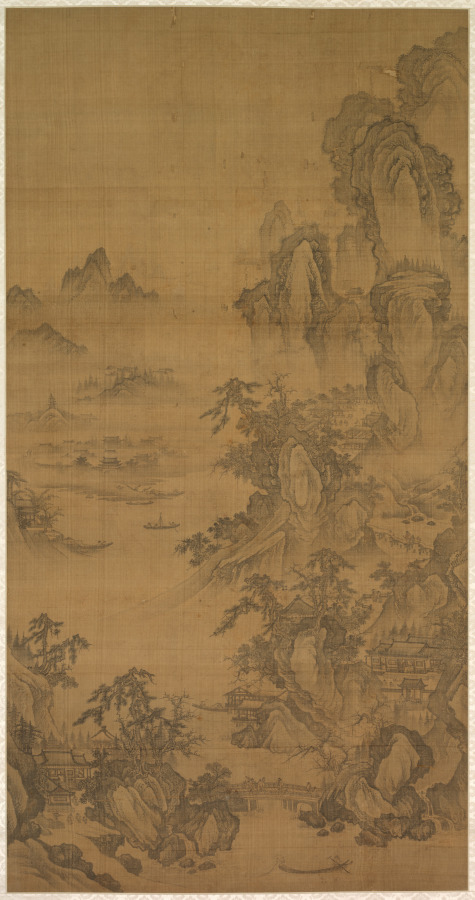
Mountain Market, Clear with Rising Mist (early 1500s) is in the Cleveland Museum of Art collection.
The work and its context
The museum's open-access catalogue describes the work:
This painting depicts several vignettes of the scholar-hermit’s various activities. In the lower left corner, the scholar-hermit is portrayed welcoming his guest in the courtyard. In the middle section on the lower bottom, the scholar and his guest are shown encountering another traveler on the bridge and exchanging their greetings. After crossing the bridge, the scholar visits a friend who lives in a compound of multiple buildings. The two friends decide to take a short walk. Both appear in a terraced cliff, enjoying a mountain vista and the fragrance of an old pine tree carried by the gentle wind. The scholar continues his journey with his two servants. They are portrayed crossing a winding wooden bridge. Right beyond the colossal rocky mountain, a panoramic view to a bustling market place unfolds, suggesting that it may be the place where the scholar-hermit’s entourage would visit. Perhaps the scholar need to buy items such as books, rolls of papers, and brushes, all essential to scholarly life. Toward the upper left corner, another group of travelers is landing on the river bank that leads to the city gate; they may be headed to the multistoried Buddhist stupa nestled on the top of the mountains.
Object facts
- Title: Mountain Market, Clear with Rising Mist
- Date: early 1500s
- Culture: Korea, Joseon dynasty (1392–1910)
- Type: Painting
- Technique: Hanging scroll; ink on silk
- Dimensions: Painting: 115.3 x 60 cm (45 3/8 x 23 5/8 in.); Overall: 179 x 70.7 cm (70 1/2 x 27 13/16 in.); Overall with knobs and cord: 181.8 x 77 cm (71 9/16 x 30 5/16 in.)
- Collection: ASIAN - Hanging scroll
- Department: Korean Art
- Accession number: 2015.517
A detail from the museum
Due to its stylistic features, this painting has long been believed to be a Chinese painting of the Northern Song period, dated to the 12th century.
Collection credit
Gift from the Collection of George Gund III
Further reading listed by the museum
- Ishikawa, Jun 石川淳, Yoshitaka Iriya 入矢義高, Yūjirō Nakata 中田勇次郎, and Hironobu Kohara 古原宏伸. Kō Kōbō, Gei San, Ō Mō, Go Chin [黄公望, 倪瓚, 王蒙, 呉鎮]. Tōkyō: Chūō Kōronsha, 1979.
- Suzuki, Kei. Chūgoku kaiga sōgō zuroku (Comprehensive Illustrated Catalogue of Chinese Paintings), vol. 4 of Nihon hen: Ji'in, kojin (Japanese Collections: Temples and Private Collectors). Tōkyō: Tōkyō Daigaku Shuppankai, 1982.
- Ahn, Hwi-joon. “The Origin and Development of Landscape Painting in Korea.” In Arts of Korea (New York: Metropolitan Museum of Art, 1998), 294–349.
View the collection record
See the museum's photographs and full catalogue entry. Catalogue text is reproduced from the Cleveland Museum of Art's open-access data, with HTML formatting removed. This object and its supplied image are designated CC0.
Sources
More in Lifestyle
Keep reading