Mule-Head Attachment for a Couch (200–100 BCE): Art, History and Details
Mule-Head Attachment for a Couch at the Cleveland Museum of Art: 200–100 BCE, bronze. Explore the work's context, creator attribution and collection history.
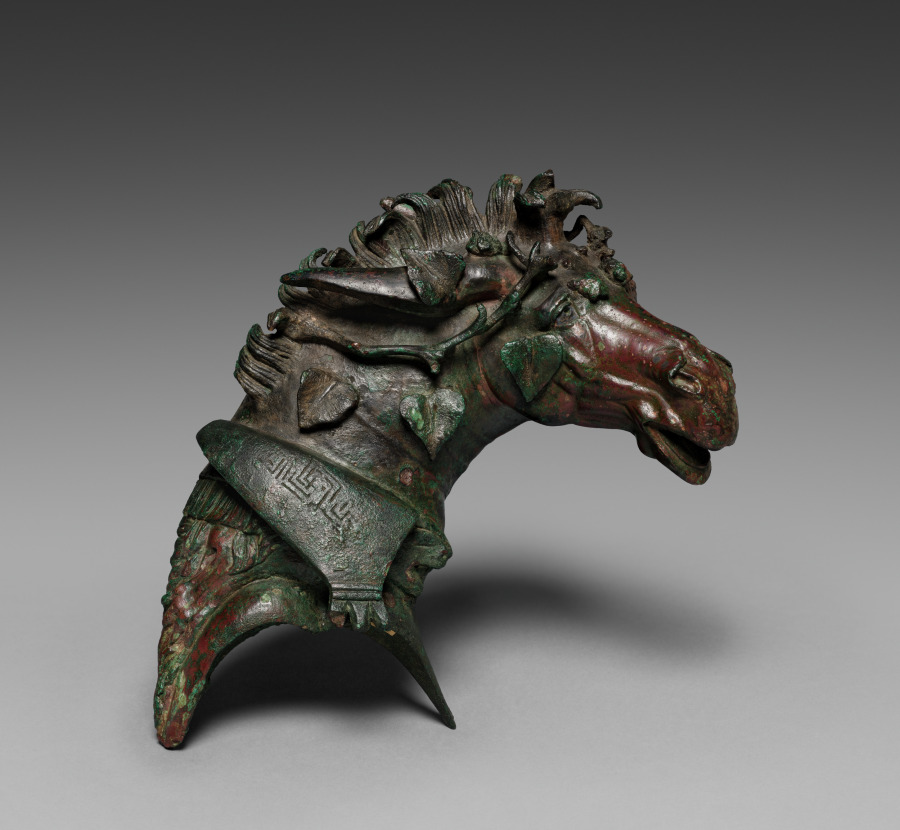
Mule-Head Attachment for a Couch (200–100 BCE) is in the Cleveland Museum of Art collection.
The work and its context
The museum's open-access catalogue describes the work:
This bronze attachment in the shape of a mule’s head was once part of a fulcrum (armrest) for a banqueting couch. The mule’s mane flies upward, its mouth open and its ears pushed back against its head. The mule wears an ivy garland and a saddlecloth made from panther skin, two elements associated with the wine god Dionysos.
Object facts
- Title: Mule-Head Attachment for a Couch
- Date: 200–100 BCE
- Culture: Greece, Hellenistic period
- Type: Sculpture
- Technique: bronze
- Dimensions: Overall: 20.4 x 18.3 cm (8 1/16 x 7 3/16 in.); with base: 25.4 cm (10 in.)
- Collection: GR - Greek
- Department: Greek and Roman Art
- Accession number: 1943.68
A detail from the museum
The pattern on the panther skin, called a meander, was also extremely popular on Greek pottery.
Collection credit
Purchase from the J. H. Wade Fund
Further reading listed by the museum
- Wunderlich, Silvia A. "A Bronze Mule's Head." The Bulletin of the Cleveland Museum of Art 30, no. 9 (1943).
- Hollis, Howard. "A Bronze Mule's Head." The Bulletin of the Cleveland Museum of Art 30, no. 9 (November 1943): 137-139
- The Cleveland Museum of Art. Handbook of the Cleveland Museum of Art/1966. Cleveland, OH: The Cleveland Museum of Art, 1966.
View the collection record
See the museum's photographs and full catalogue entry. Catalogue text is reproduced from the Cleveland Museum of Art's open-access data, with HTML formatting removed. This object and its supplied image are designated CC0.
Sources
More in Lifestyle
Keep reading
Related stories